Utility Data Management for Real Estate: Solving Data Silos at Scale

The commercial real estate industry struggles with data scattered across numerous spreadsheets, documents, and disparate software systems .... Fragmented data envrionments make generating comprehensive reports time-consuming and innefficient (BLMI Initiative, 2025).
Real estate portfolios manage billions in assets, yet most can't answer basic questions about their energy consumption.
Which building consumed the most electricity last Tuesday? Where did water usage spike by 40% overnight? Why did the gas bill double at Site 12?
Without accurate utility data, these questions go unanswered. Costing portfolios millions in wasted energy, failed audits, and missed ESG targets.
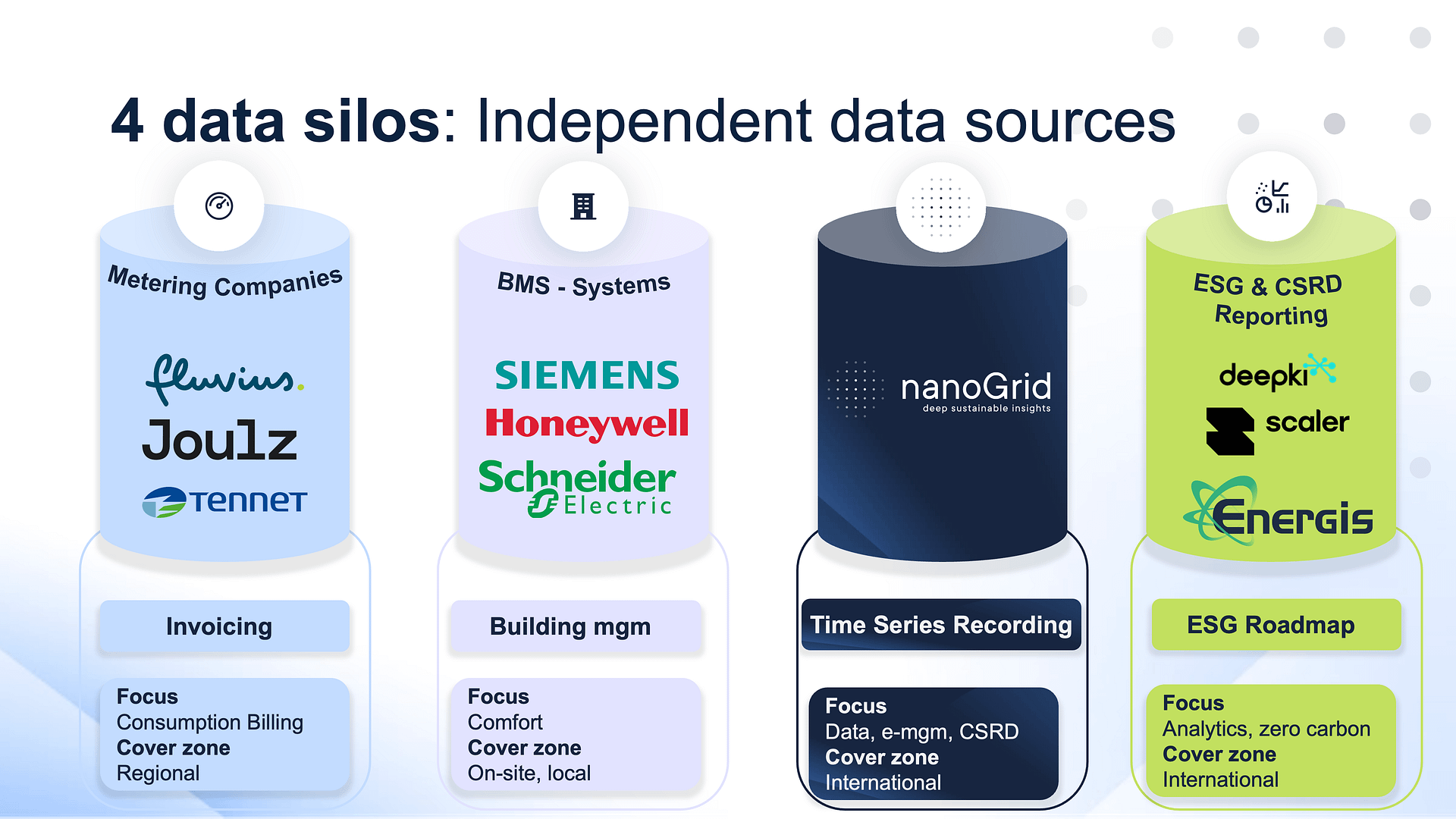
The problem isn't a lack of meters or management systems. It's fragmentation. Utility data sits trapped across four silos:
- metering companies focused on billing;
- building management systems designed for local control;
- analytics platforms hungry for clean data;
- and a missing foundation that connects them all.
When consumption data lives in disconnected spreadsheets, monthly invoices, and isolated BMS dashboards, real estate companies lose visibility, control, and credibility.
This article introduces the utility data integration layer: a foundational infrastructure that collects, validates, and structures all utility data across your portfolio.
We'll explain why time series data matters for ESG compliance, how this layer differs from BMS and EMS systems, and why leading portfolios now treat utility data management as non-negotiable infrastructure.
The Four-Silo Problem in Real Estate Utility Data Management
Why Most Portfolios Suffer From Fragmented Utility Data
Real estate portfolios operate in a data paradox
Buildings are equipped with smart meters, BMS platforms monitor HVAC systems, and ESG software promises sustainability insights. Yet when management needs a complete picture of utility consumption across their portfolio, the data doesn't exist in one place.
The reality: utility data sits scattered across metering companies tracking monthly reads, building management systems controlling local equipment, invoices buried in accounting software, and ESG tools waiting for manual input.
Each system serves its purpose in isolation, but none were designed to work together. This fragmentation creates blind spots that grow exponentially with portfolio size.
Multi-site enterprises and commercial real estate operators feel this pain acutely. A logistics company managing 50+ distribution centers across Europe faces a familiar scenario: Q1 ESG reporting deadline approaching, sustainability team scrambling to compile electricity, gas, and water data from dozens of utility providers, multiple BMS vendors, and fragmented invoicing systems. Three weeks of manual work produces a report with 30% data gaps and zero audit trail. The board questions the numbers. Investors demand verification. The company realizes their sustainability strategy is built on quicksand.
This isn't an exception: it's the industry standard. The root cause isn't incompetence or lack of investment. It's structural: real estate utility data management operates in four disconnected silos.
The Four Data Silos Blocking Portfolio-Wide Energy Management
Silo 1: Metering Companies & Billing Services
Metering companies and utility providers exist to deliver one thing: accurate invoices. They install meters, record consumption, and bill customers based on regulatory requirements. For electricity, gas, and water, these services provide the official numbers that determine what you pay.
The limitation is fundamental: metering services are designed for billing intervals, not operational insight. Most deliver monthly or quarterly readings. Sometimes just annual totals with estimated interim invoices. When data arrives, it's fragmented by utility provider, region, and contract.
A portfolio spread across multiple countries might work with 20+ different metering companies, each with their own data format, portal, and reporting schedule.
Silo 2: Building Management Systems (BMS)
Building Management Systems control the physical environment inside your properties. They manage HVAC systems, adjust lighting based on occupancy, and maintain comfort levels. Modern BMS platforms are sophisticated pieces of technology that keep buildings running efficiently at the local level.
The limitation is their scope and purpose: BMS platforms are siloed per building and designed for control, not data analysis. Each property typically has its own BMS, often from different vendors installed at different times. These systems excel at regulating temperature and managing equipment but weren't built to aggregate consumption data across portfolios or store long-term history for trend analysis.
Silo 3: Energy & Utility Data Layer (the missing link)
Between metering services and analytics tools sits a gap most portfolios don't realize exists: the utility data integration layer.
This is where all utility data (electricity, gas, water, heat) should be collected, validated, and structured before flowing anywhere else. Most organizations have metering companies delivering invoices, BMS platforms controlling buildings, and ESG tools generating reports. None of them own the layer in between.
What this layer does
Connects to every meter across your portfolio regardless of type, age, or utility provider. Captures consumption at high frequency, typically minute-level intervals. Validates data quality in real-time through automated gap detection and quality scoring. Structures everything into hierarchical models matching your organizational needs like country, site, building, meter.
The result is clean, complete, audit-ready data accessible via API. Your ESG platform, ERP system, and analytics tools pull from one verified source instead of fragmented spreadsheets and manual uploads. Full traceability runs from raw meter reading to aggregated dataset.
Why it's different
This layer focuses exclusively on data accuracy, completeness, and traceability. Not billing like metering services. Not control like BMS platforms. Not analysis like energy management software.
It's the foundational infrastructure that makes everything else work. Without it, you're building analytics on quicksand. This integration layer doesn't replace your existing systems. It makes them work together. To understand how this hub relates to your BMS, metering services, and ESG platforms, explore our guide to esg data integration.
Silo 4: ESG Platforms & Analytics Tools
ESG platforms and analytics tools sit at the top of the stack. They generate compliance reports for CSRD, calculate GRESB scores, benchmark performance against industry standards, and produce executive dashboards showing sustainability progress. These are powerful systems designed to turn data into business intelligence.
The limitation is: they're only as good as the data fed into them. Most ESG platforms accept manual CSV uploads, invoice data, or estimated values. When portfolio managers can't provide complete, verified utility data, these tools produce reports built on gaps, estimates, and assumptions.
More software isn't the answer. Solving fragmented utility data requires a different starting point: infrastructure. When your data layer is solid, everything built on top of it: monitoring, reporting, compliance, actually works.
What is Utility Data Management? (And why it's not what you think)
Defining Utility Data Management in the Real Estate Context
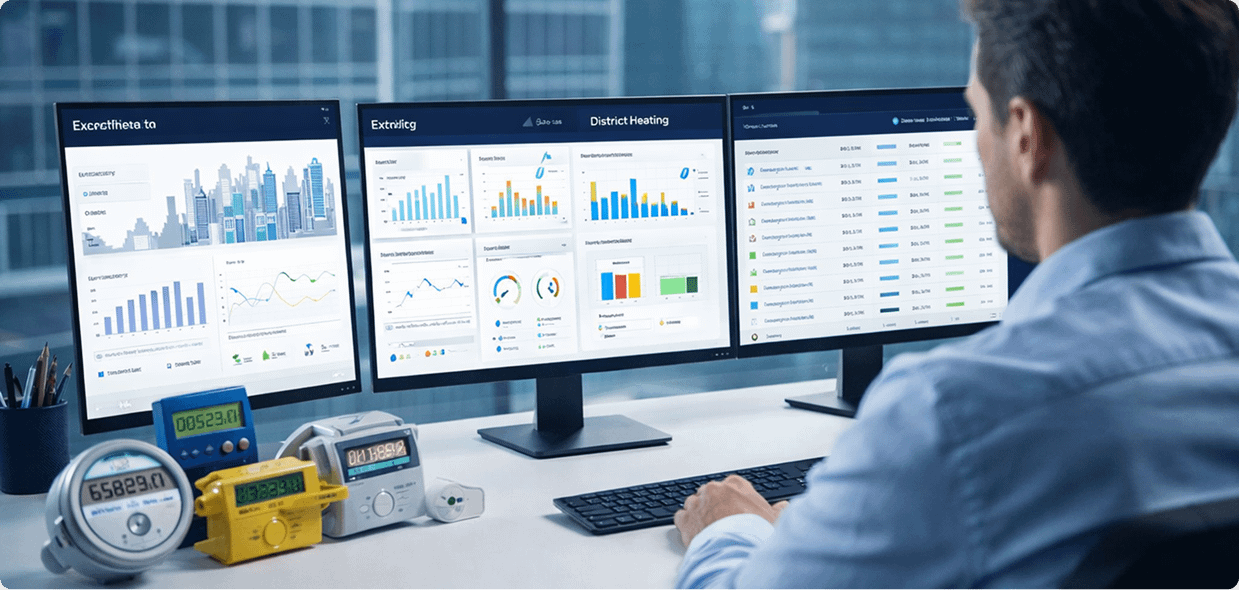
When hearing about "utility data management," many think of Meter Data Management (MDM) systems used by utility companies. Traditional MDM platforms were built for electricity providers, gas distributors, and water utilities to manage billing for millions of residential customers. They collect meter readings, validate consumption, detect tampering, and generate invoices at scale.
Real estate utility data management is fundamentally different. You're not billing millions of households. You're managing electricity, gas, water, and heat consumption across hundreds of properties spanning multiple countries. Your challenge isn't processing millions of monthly reads; it's integrating data from diverse metering infrastructure, multiple utility providers, legacy building systems, and modern IoT devices into one coherent view.
The difference is architectural: Portfolio-scale data collection requires connecting any meter type (smart, legacy, analog), any utility (electricity, gas, water, district heating), and any data source (utility company APIs, on-site hardware, BMS integrations) into a unified system. Single-utility MDM systems weren't designed for this. They handle one utility type, one regulatory framework, one billing cycle. Real estate portfolios need a system that treats utility data as strategic infrastructure not just billing inputs.
This is utility data management for real estate: turning fragmented consumption data across your entire portfolio into a single, structured, audit-ready asset.
What is Utility Data? Beyond monthly invoices
Utility data encompasses every measurement of resource consumption across your properties. Most portfolios think of utility data as monthly invoices. The summary numbers that determine what you pay. In reality, utility data is far richer and more complex.
The reality is that utility data isn't one thing delivered one way. It's a complex web of measurements, formats, and sources that must be unified before it becomes useful for management, analysis, or reporting.
Energy Data Management vs. Utility Data Management
These terms get used interchangeably. They describe fundamentally different functions.
Energy Management: Optimization and Action
Energy Management Systems (EMS) analyze consumption patterns, identify waste, and recommend efficiency improvements. Some automate control decisions to reduce demand.
They answer: Which buildings underperform? Where can we cut costs? What savings will a lighting retrofit deliver?
Energy management is about taking action to improve efficiency.
Utility Data Management: The Backbone of Your Portfolio
Utility data management ensures accurate, complete, traceable data reaches your energy management tools in the first place.
It handles data collection from all meters and sources. Validates quality and completeness. Structures information into portfolio hierarchies. Provides API access for downstream systems.
It answers: Do we have consumption data for every site? Is this data accurate and verified? Can we prove these numbers in an audit?
Why You Need Both (And Why Data Comes First)
Energy management systems can't optimize what they can't measure accurately. ESG platforms can't report what isn't collected reliably.
You can install sophisticated analytics software, but if the underlying utility data is incomplete, delayed, or unverified, every insight becomes questionable.
Utility data management isn't glamorous. It doesn't generate dashboards or recommend efficiency projects. It does something more important: it ensures the foundation is solid.
Most portfolios get the order wrong
They rush to analytics before establishing data infrastructure. Deploy EMS platforms pulling from fragmented sources, producing insights nobody trusts. Submit ESG reports auditors reject due to data gaps. Make investment decisions based on estimates rather than verified consumption.
The companies getting it right do it in reverse: foundation first, analytics second. They recognize utility data is infrastructure, as essential as networking or security systems.
Once that infrastructure is in place, everything built on top works better.
Conclusion: Why the Integration Layer is Non-Negotiable
Fragmented utility data isn't a minor inconvenience. It's a structural barrier blocking cost control, ESG compliance, and portfolio scalability.
The four-silo problem (metering companies, BMS platforms, analytics tools, and the missing data layer) ensures no system can deliver complete, audit-ready insights.
The solution is recognizing utility data management as foundational infrastructure. Before analytics, before ESG platforms, before optimization strategies: you need accurate, complete, traceable data flowing from every meter across your portfolio.
Companies treating this as infrastructure rather than afterthought are the ones passing CSRD audits, proving ESG performance to investors, and catching waste before it costs millions.
Recognizing the need for a utility data integration layer is step one. Understanding why your BMS, metering companies, and ESG tools can't fill this role is step two our article on esg data integration explains exactly where each system falls short.
Ready to see what audit-ready utility data looks like across your portfolio?
Book a demo to discover how nanoGrid's integration layer connects your existing meters, validates data quality in real-time, and delivers traceable consumption records to your ESG platforms. Without replacing the systems you already have.
Frequently Asked Questions
What is utility management?
Utility management is the process of monitoring, analyzing, and optimizing consumption of electricity, gas, water, and heat across a real estate portfolio to control costs and support sustainability goals.
What is MDM in utilities?
Meter Data Management (MDM) systems collect, validate, and store meter readings—primarily for billing purposes in the utilities sector. In real estate, MDM refers to managing consumption data across portfolio-wide metering infrastructure.
What is utility data?
Utility data includes all recorded measurements of resource consumption: electricity (kWh), gas (m³), water (liters), and thermal energy. It encompasses interval data, time-series records, pulse counts, and analog signals from smart meters, legacy meters, sub-meters, and BMS sensors.
What is a utility management system?
A utility management system is software infrastructure that collects, validates, structures, and provides access to consumption data across multiple sites, enabling portfolio-wide monitoring, ESG reporting, and cost analysis.
What is energy data management?
Energy data management is the foundational layer ensuring accurate, complete utility data collection before analysis or optimization. It differs from energy management (which focuses on reduction strategies) by prioritizing data quality, traceability, and audit readiness.
What are the four types of energy management?
The four types are: (1) Monitoring & Measurement, (2) Analysis & Benchmarking, (3) Optimization & Control, and (4) Reporting & Compliance. All require reliable utility data as their foundation.
What is the main function of EMS?
Energy Management Systems (EMS) analyze consumption patterns to identify waste, recommend efficiency improvements, and sometimes automate control decisions to reduce energy demand and costs.
What are utilities systems?
Utilities systems refer to the infrastructure managing essential building services—electricity distribution, gas supply, water networks, heating, and cooling—plus the software platforms monitoring and controlling these resources.