BMS vs EMS: Which System Does Your Building Need in 2025?
.jpg)
In 2025 and onwards, buildings face a triple shift: rising energy costs, stricter CSRD reporting, and growing pressure from tenants who expect transparency, comfort, and efficiency all at once.
Facility managers are constantly being asked to do more, with less room for error, less time to react, and fewer blind spots allowed.
And yet, most buildings still rely on just one system.
The Current Technology Gap
Roughly 70% of commercial properties have a Building Management System (BMS) in place, but only 44% use an Energy Management System (EMS) to track and optimize energy use (source: Entouch).
The gap goes beyond technology, it affects operations too. While a BMS keeps your lights (literally on and HVAC running, it doesn't always tell you how efficiently things are working. Or why your utility bill spiked last month. Or how close you are to your CO₂ target.
That’s why this comparison matters now. Too many teams confuse control (what BMS does) with insight (what EMS provides). And too many teams try to drive sustainability or savings using systems never built for that job.
In this article, we’ll break down what each system does, where they overlap, and how pairing both, especially with modern platforms like nanoGrid, can unlock smarter, faster, more accountable building operations.
BMS vs EMS: the differences
What Is a Building Management System (BMS) ?
A Building Management System (BMS) is the operational backbone of most smart buildings. It’s a centralized control system that manages and automates essential services, HVAC, lighting, ventilation, fire safety, access control, and security systems.
A BMS enables unified management and monitoring of these building functions from a centralized location, enhancing efficiency and response times. Mainly to ensure comfort, safety, and efficient day-to-day operations.
Rather than offering deep analytics, a BMS focuses on automation systems that adjust settings based on time, occupancy, or thresholds. This automation is made possible by advanced technology, which enables smart building features and seamless integration of various subsystems. Think temperature regulation after hours, lights off in unused zones, or fire alarms triggering ventilation shutdowns. In other words: it’s about running the building smoothly, not analysing its performance.
BMS has become the standard in most commercial real estate buildings. But it often lacks the detail needed for energy insights or regulatory proof. Important? yes! But not enough.
👉 For a full breakdown of how BMS systems work (including protocols, components, and use cases), see our in-depth guide: What Is a Building Management System (BMS)?.
Next up, let’s explore the breakthrough system that doesn’t try to control your buildings, but instead unlocks the real intelligence behind how they actually consume energy.
What Is an Energy Management System (EMS)?
Where a BMS controls, an EMS observes.
An Energy Management System (EMS) is built to monitor, measure, and optimize a building’s energy use across multiple utilities and assets, in real time. EMS collects equipment data from various systems to provide detailed insights into energy consumption and identify opportunities for efficiency improvements.
It’s not about running your HVAC. It’s about understanding what that HVAC is costing you, like how many energy usage there is.
The adoption of EMS is becoming a standard in the industry for organizations seeking to improve energy efficiency and compliance.
EMS Definition: Built for Energy Insights
An EMS is a dedicated software and hardware platform that collects granular data from utility meters: electricity, gas, water, and even sub-loads. It tracks consumption across equipment, floors, or entire buildings.
The goal: give energy managers and facility operators the visibility they need to make data-backed decisions. While giving sustainability teams the accurate data they need for reporting.
Unlike traditional automation systems, EMS tools are not just about response. They’re all about analysis.
Key Capabilities of an EMS: an overview
- Real-time monitoring across energy streams provides instant visibility into consumption patterns, spikes, and anomalies. This enables immediate detection of issues and opens up optimization opportunities before they impact costs or operations.
- Utility analytics and benchmarking allows you to compare building performance across portfolios or over time. The result: data-driven performance optimization and the ability to conduct competitive analysis across assets.
- Forecasting and trend analysis helps detect seasonal shifts, equipment inefficiencies, or night-time waste. This supports proactive maintenance planning and smarter energy strategies.
- Audit-ready reporting generates traceable logs aligned with frameworks like CSRD, GRESB, or internal ESG metrics. It simplifies compliance and strengthens sustainability reporting with reliable, verifiable data.
- Site-wide and asset-level views serve both building owners and tenants managing operational expenses. This flexibility allows different stakeholders to monitor exactly what matters to them.
.png)
Why It Matters in 2025
Energy has moved beyond a simple expense. Rising costs, carbon accounting targets, and compliance demands push companies toward EMS tools that track, verify, and reduce use. EMS systems are specifically designed to meet regulatory requirements, support documentation and validation, and ensure audit readiness for quality and sustainability assurance.
In fact, research shows that while 70% of companies use a BMS, only 44% have implemented an EMS (source: Entouch). That leaves a visibility gap in buildings that look “smart” on paper but fall short without minute-level accurate data.
When adopting EMS solutions, it is crucial to choose a provider that offers reliable service and ongoing support to meet the evolving needs of your facility.
TL;DR: EMS vs Control Systems
To sum up: A BMS tells a building what to do. An EMS tells you if it worked, how well, and what it cost.
As a next step: we’ll compare EMS and BMS directly, because both have a role to play. And the difference matters more than ever right now.
BMS vs EMS: The Core Differences
Building Management Systems (BMS) and Energy Management Systems (EMS) are often grouped together in sustainability discussions, but they solve fundamentally different problems.
While both contribute to a building’s efficiency, understanding how they differ, yet complement one another, is key for any organization looking to reduce costs, meet compliance, or optimize energy performance. Integrating BMS and EMS is essential for achieving optimal building performance, as these systems coordinate to improve energy, comfort, and compliance across modern facilities.
Let’s explore their unique roles, how they collect and use data, and what that means for operational outcomes.
Systems Managed: Control vs Consumption
A BMS focuses on operational control. It runs your HVAC, lighting, fire alarms, and access systems. The job is simple: keep people comfortable and safe while maintaining basic efficiency. Think of it as the system that actually makes things happen in your building.
An EMS focuses on energy consumption. It pulls data from meters and IoT devices to show exactly how much electricity, gas, or water you're using and where it's going. While your BMS turns on the HVAC, your EMS tells you that same unit burned through 47 kWh last Tuesday at 4:47 p.m. It's all about tracking actual usage, spotting trends, and catching problems before they hit your utility bill.
So, where BMS manages what happens, EMS tells you what it costs.
Data Depth: Status vs High-Frequency Insights
Here lies one of the most important distinctions: data granularity.
A BMS tracks equipment status. Is the HVAC on? Did the temperature hit its setpoint? Are the doors locked? It works with basic schedules and simple on/off logic. Perfect for keeping things running, but it won't give you the detail needed for energy audits or strategic planning.
An EMS captures minute-level energy data. It pulls real-time consumption from your electricity, gas, and water meters across your entire portfolio. This granular data lets energy teams spot irregular usage, benchmark performance, catch unexpected spikes, and build solid evidence for CSRD and GRESB reporting.
Bottom line: BMS shows what's running. EMS shows what's consuming—and what that costs you in dollars and emissions.
Output and Use: Control vs Optimization
A BMS is your actuation platform. It takes inputs like temperature readings or motion detection and immediately acts on them. Lights go off after hours, airflow adjusts, alarms trigger when needed. It's direct control using preset rules to keep your building running smoothly.
An EMS is your insight engine. It crunches energy data to spot trends, flag waste, and recommend improvements. Instead of controlling equipment, it gives you the intelligence to optimize energy use, cut costs, and hit sustainability targets through smarter decisions.
You can think of it this way:
BMS acts. EMS advises.
And together, they form a feedback loop that connects operations with strategy.
Comparing options in the market? See top 10 building management system companies.
Why Use Both: From Control to Intelligence
BMS and EMS are often seen as separate, but the real value comes when they work together. In 2025, relying on just control or just analytics isn’t enough. Facility teams, asset owners, and ESG leaders need both: instant control and traceable data intelligence.
When paired, these platforms shift operations from reactive to strategic. Together, they enable a feedback loop where data leads to action, and action can be measured, reported, and improved over time.
By connecting granular utility data with operational controls, organizations can achieve three outcomes at once:
· Greater energy efficiency
· Regulatory and ESG compliance
· Lower lifetime operating costs
How EMS Data Feeds Smarter BMS Logic
Traditionally, BMS logic is fixed. Lights turn off at 7 p.m., HVAC runs on preset schedules, end of story. But when you feed EMS data into that equation, everything changes. Your BMS can now adapt based on actual energy patterns, not just time clocks. Machine learning takes it further, using AI to spot usage patterns and predict the best settings before you even need them.
For example:
· If the EMS detects an increase in energy use from a specific HVAC unit during off-hours, that insight can prompt the BMS to adjust setpoints or reduce runtime.
· If occupancy data shows underutilized zones, the BMS can dial down ventilation or lighting in real time, based not just on time, but on actual need.
This isn’t just “more automation”, it’s smarter automation, where decisions are informed by actual consumption patterns, advanced data analysis, and real-time feedback.
Case Example: From Detection to Correction
Let’s say your EMS, powered by a system like nanoGrid, flags an unexplained energy spike in ventilation overnight at one of your properties.
The spike wasn’t scheduled, and no alarms were triggered. So the BMS alone wouldn’t have caught it.
Here’s what happens next:
- EMS insight: Minute-level energy data reveals that one air handling unit has been running at full load due to a misconfigured occupancy sensor.
- BMS response: Based on that alert, the BMS either adjusts the schedule or triggers a maintenance intervention.
- Result: The issue is resolved in hours, not weeks. Energy waste is stopped. No audit flags. Comfort levels remain stable.
This kind of synergy prevents hidden inefficiencies from becoming recurring costs, and it’s exactly why both systems matter.
The nanoGrid Advantage: Visibility Without Rip-and-Replace
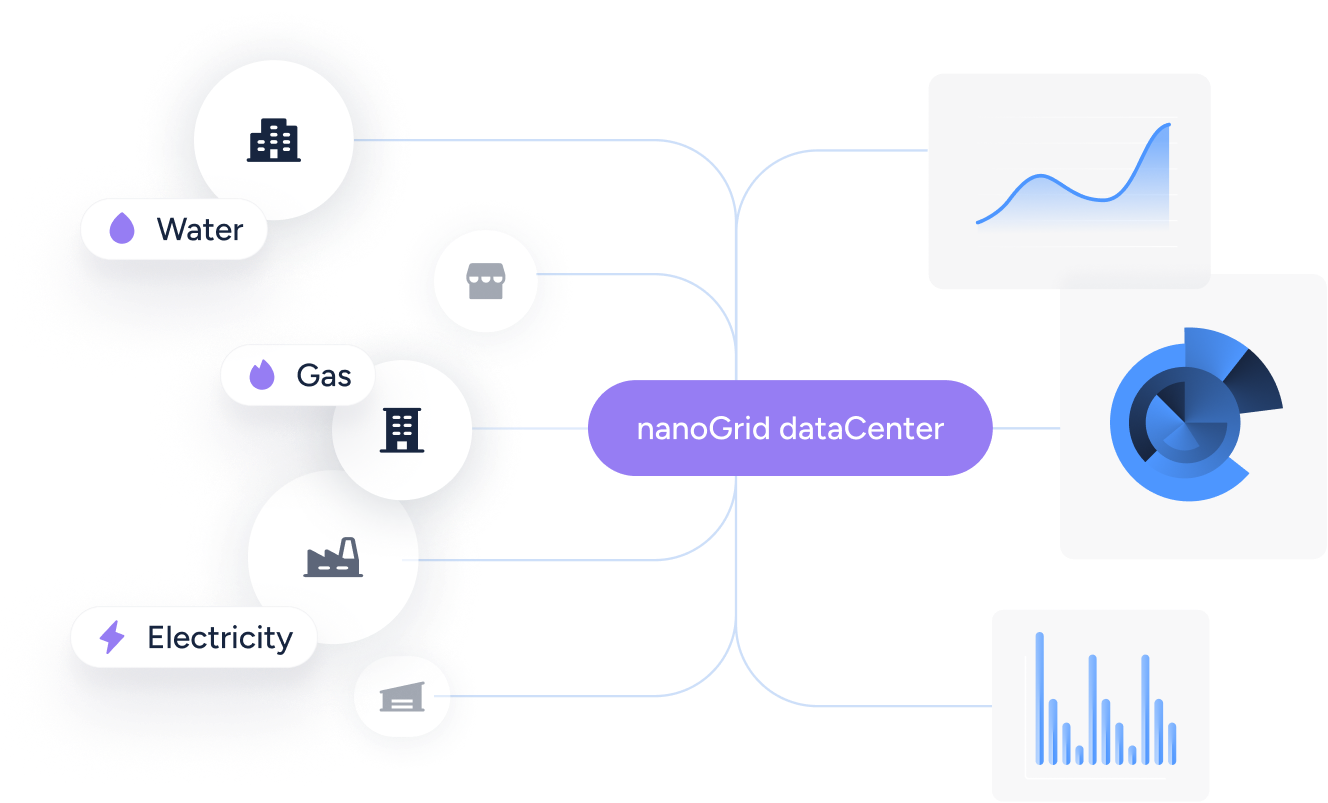
nanoGrid acts as a modern EMS layer that works with your existing BMS. Instead of ripping out your control systems. It adds the data intelligence layer you’re missing.
Whether you’re running commercial buildijngs, labs, warehouses, or data centers. nanoGrid enhances what you already have by offering:
· Minute-level utility data
· Full traceability for CSRD, GRESB, and ESG
· Portfolio-wide insights across water, electricity, and gas
Because it works in parallel with your BMS, nanoGrid fills the blind spots without breaking what already works.
➡️ Learn how BMS and nanoGrid complement each other in our detailed guide.
Next, we’ll take a closer look at how nanoGrid functions as a modern EMS layer working alongside your BMS and delivering the data your team, auditors, and investors need.
How nanoGrid Complements Both BMS and EMS
Most buildings already have some form of control in place. Some are exploring real-time monitoring. But very few have the traceable, minute-level data needed to prove compliance, optimize costs, and usage for ESG purposes.
That’s where nanoGrid fits in.
Rather than replacing your existing BMS or EMS, nanoGrid acts as a non-invasive, EMS-like layer that plugs into your current infrastructure. Extracting precise energy, water, and gas data across your entire portfolio.
Submetering Without the Complexity
nanoGrid uses plug-and-play submetering hardware that works with sealed or legacy meters. This enables real-time monitoring of individual circuits, assets, or zones. Without disrupting operations or requiring invasive retrofits.
Once connected, nanoGrid begins collecting:
- Minute-level consumption data across electricity, water, gas, and heat
- Operational anomalies (e.g. nighttime waste, simultaneous heating/cooling)
- Environmental data overlays (for refrigerants, air quality, etc.)
All of this is centralised into a SaaS solution, designed for both building operators and ESG teams.
From Utility Data to ESG-Ready Reporting
What sets nanoGrid apart is its ability to turn raw meter signals into audit-ready insights.
Instead of exporting data manually or relying on outdated spreadsheets, nanoGrid provides:
- Automatic CSRD-ready reports with embedded time-series logging
- Full traceability across sites, meters, and equipment
- Granular utility performance metrics aligned with frameworks like GRESB, BREEAM, LEED, and CRREM
For practical steps to align control and compliance, read sustainable building management.
The Final Relation Between Automation and Accountability
You know already know by now how BMS controls building systems and EMS tracks consumption. But nanoGrid completes the picture by making your data traceable, accurate, verifiable, and actually useful for compliance.
Where other EMS platforms struggle with legacy systems, nanoGrid excels. It turns data into insights that improve BMS decisions and support ESG reporting, keeping your team ahead of the curve.
Want the full comparison? Check out BMS vs nanoGrid to see how adding nanoGrid transforms basic control into compliance-ready performance.
Conclusion: Control and Insight Are Better Together
When it comes to building performance in 2025, it’s no longer a choice between automation and analytics. You need both.
A Building Management System (BMS) gives you the tools to control HVAC, lighting, fire safety, and access systems. Keeping occupants comfortable and operations running smoothly.
An Energy Management System (EMS) adds the missing layer: real-time visibility, subload insights, and traceable data that unlock ESG compliance and cost savings.
Used together, they transform your building from reactive to resilient.
From scheduled to strategic. From managed… to measurable.