Top 10 Building Management System Companies to Know (And how to compare them)
.png)
Choosing the right building management system (BMS) isn’t just a technical decision in 2025, it’s a strategic one. As energy prices climb, (ESG) regulations tighten, Europe’s BACS and tenants expect better experiences, facility managers are under growing pressure to control both costs and carbon. And that means your BMS needs to deliver more than just temperature control or lighting schedules.
The building automation industry is rapidly evolving, driven by advancements in technology and increasing demands for intelligent, energy-efficient solutions. Advanced technology, such as IoT integration and artificial intelligence, is transforming building automation solutions and enabling smarter, more efficient building systems.
In the past, most BMS solutions were built for one purpose: comfort. Today, building automation solutions integrate various building systems—like HVAC, lighting, security, and energy management, to support the needs of modern infrastructure. They automated HVAC systems, controlled lighting, and ensured operational safety across commercial buildings and industrial sites. That still matters but today, it’s not enough.
Modern buildings need a system that does more than control, they need one that informs. Real-time energy usage. Automated fault detection. Data that’s traceable for GRESB, CSRD, and sustainability reports. And platforms that integrate nicely with everything from submetering hardware to cloud dashboards.
Europe’s BACS deadline is closer than you think
New EU rules require non-residential buildings with HVAC systems over 290 kW to install BACS (Building Automation and Control Systems) by end of 2025. These systems must monitor, analyze, and optimize energy use. Building energy management systems play a crucial role in helping facilities enhance energy efficiency and meet regulatory requirements. The goal: cut building energy consumption by up to 14% across Europe and make digital controls standard for decarbonization (European Commission, eu.bac).
That’s where the gap is starting to show.
The market splits into two camps: established BMS vendors with proven hardware, and modern IoT platforms built for analytics and real-time building control. The real question isn’t about feature lists. It’s about scalability and future compliance. Which system adapts as regulations tighten and your portfolio grows?
A key differentiator among top vendors is their ability to deliver innovative solutions and leverage cutting edge technology, such as IoT, AI, and advanced analytics, to optimize building performance and sustainability.
In this article, you’ll get:
- An overview of the top building management system companies leading the market in 2025
- Side-by-side insights into their capabilities, IoT readiness, and analytics strength
- A smart alternative for energy data traceability: how nanoGrid complements your BMS with minute-level visibility and compliance-ready utility data
Let’s start with the big picture.
The $100B+ BMS market and where it’s headed
The global market for building management systems (BMS) is on a steep upward curve. According to Precedence Research (2025), the market is valued at around $23 billion in 2025 and is forecasted to reach over $80 billion by 2034, a growth trajectory consistent with a 15% CAGR. Broader intelligent building automation technologies are projected to surpass $100 billion by 2025, highlighting the scale and convergence of automation markets driving this expansion (EC&M, 2019).
Need a quick refresher on components and scope? See what is a building management system.
Building management systems have become infrastructure essentials enabling centralized control and automated operations across facilities. Growth through 2030 reflects what's happening across sectors: rising energy costs, stricter efficiency mandates, and sustainability commitments that require smarter building technology.
A perfect storm of pressure and opportunity
Fluctuating energy prices have made energy efficiency a top priority. Facility teams are looking for ways to cut consumption while keeping spaces comfortable. A properly configured BMS optimizes HVAC, lighting, and ventilation in real time, often autonomously, turning energy management from reactive to strategic (Renub Research, 2025).
Regulation is also reshaping the landscape. In Europe, compliance requirements under CSRD, GRESB, BREEAM, and EPRA frameworks demand traceable, audit-ready performance reporting. Globally, ESG accountability is making energy transparency a boardroom issue, not just an engineering one.
Tenant expectations have shifted. Occupants want better air quality, consistent temperatures, and responsive environments. Meeting those standards, while hitting ESG targets, requires systems that optimize operations and comfort at the same time. That's what modern BMS platforms deliver.
From Control to Compliance
Historically, BMS platforms were engineered to manage building fundamentals, HVAC, lighting, and fire safety, ensuring safety and occupant comfort. But in 2025, BMS technology has moved beyond simple automation. As noted by Mordor Intelligence (2025), modern systems integrate predictive maintenance, ESG tracking, and energy analytics into unified operational ecosystems across portfolios.
An integrated building management system is now essential for optimizing building performance, as it consolidates various building systems and smart technologies to enhance operational efficiency, occupant comfort, and energy conservation.
As the next section explores, not all vendors deliver these capabilities equally. It is important to evaluate providers that offer integrated solutions and a comprehensive suite of features, while understanding who’s leading the charge in innovation.
If you’re weighing control versus analytics, this comparison: bms vs ems clarifies when you need both.
Top 10 Building Management System Companies in 2025
In today’s landscape, not all BMS vendors are created equal. Many building management systems are available on the market, each offering unique automation solutions tailored to different operational needs. While many offer strong control capabilities, fewer deliver on modern demands: real-time analytics, IoT integration, ESG readiness, and system-wide interoperability.
Below, we profile 10 key players shaping the BMS market in 2025, from global leaders to more niche innovators.
1. Johnson Controls : Metasys
Johnson Controls remains a global leader in building automation systems. Its flagship BMS, Metasys, offers comprehensive control across HVAC, lighting, fire, and security systems.

What makes Metasys stand out in 2025 is its flexibility across protocols (BACnet, Modbus, LonWorks), its open architecture, and a strong focus on integration with third-party platforms. The interface is intuitive, mobile-ready, and supports real-time alerts and remote troubleshooting.
For facility managers focused on interoperability and enterprise-wide control, Johnson Controls continues to set the bar.
2. Schneider Electric : EcoStruxure Building Operation
EcoStruxure by Schneider Electric goes beyond traditional control, offering cloud-native functionality, advanced energy dashboards, and native IoT sensor support.
Its strength lies in ESG integration and energy analytics.
EcoStruxure can connect with sustainability frameworks like LEED and GRESB, helping building owners optimize energy usage through energy efficiency while meeting reporting requirements. EcoStruxure also integrates with energy management systems to provide comprehensive energy oversight.
A go-to choice for those prioritizing energy performance, compliance, and smart infrastructure.
3. Honeywell : Forge & Enterprise Buildings Integrator (EBI)

Honeywell Forge and EBI combine industrial-grade control with predictive analytics and data visualization.
Forge, in particular, is designed for cloud scalability, offering portfolio-wide visibility and AI-driven insights. These platforms deliver insights, enabling building operators to make informed decisions that optimize efficiency, maintenance, and occupant comfort.
Used heavily in airports, hospitals, and critical infrastructure, Honeywell’s platforms offer robust redundancy, life safety systems integration, and uptime monitoring.
Ideal for operators who want deeper intelligence layered on top of rock-solid control, while achieving significant cost savings through operational efficiencies.
4. Siemens : Desigo CC
Siemens Desigo CC positions itself as a unified platform for integrated building management systems, combining HVAC, lighting, power, fire, and security into one dashboard.
Desigo CC targets smart building and mission-critical data center infrastructure with native digital twin functionality, AI-driven anomaly detection, and predictive energy modeling. These features work together to enhance system performance and reliability, supporting energy efficiency and effective building operations.
For large, complex sites requiring resilient automation with advanced data tools, Desigo CC is a solid bet.
5. Carrier : i-Vu Building Automation System
Carrier's i-Vu combines ease-of-use with energy reporting and remote access, making it popular in commercial buildings that need straightforward deployment.
The system integrates with electrical equipment across facilities, enabling centralized control that reduces operational costs and cuts energy waste through better monitoring. While i-Vu doesn't lead on analytics depth, it delivers strong mobile workflows and reliable cloud connectivity.
A reliable option for facilities modernizing from legacy systems without overhauling their entire stack.
6. Bosch : Energy and Building Solutions
Bosch delivers integrated building automation focused on energy savings and operational simplicity. Solutions scale across industrial buildings, healthcare facilities, and smart campuses.
With growing AI and predictive maintenance capabilities, Bosch targets operations teams prioritizing long-term efficiency and reduced carbon footprints. A quiet leader for industrial-strength performance with sustainability in mind. Bosch's solutions actively support the development of sustainable buildings by enabling energy-efficient automation and environmentally responsible management practices.
7. ABB : Cylon and ABB Ability
ABB's acquisition of Cylon Controls reinforced its building management infrastructure capabilities. The ABB Ability™ platform delivers unified control across HVAC, lighting, electrical distribution, and access control systems, enabling centralized monitoring and automation of a building's operations at enterprise scale.
Core differentiators include protocol-agnostic architecture and global deployment compatibility, optimized for multinational portfolios and legacy infrastructure integration.
For facility managers looking to align BMS control with broader digital infrastructure goals, ABB delivers.
8. Trane : Tracer SC+ and Tracer Ensemble
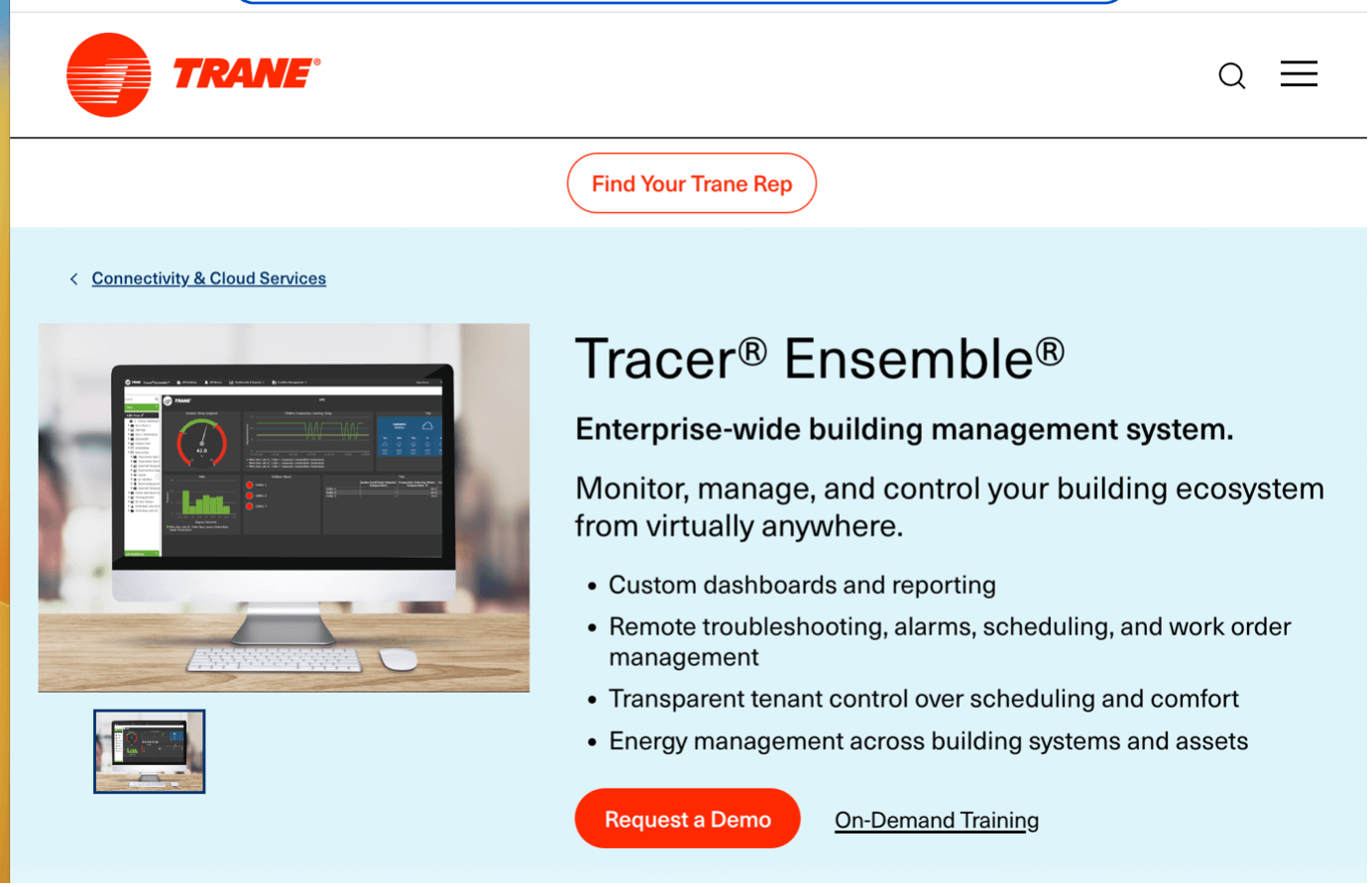
Trane built its building automation platforms around HVAC excellence. Trane's solutions integrate advanced air conditioning controls to optimize occupant comfort and energy use. Tracer SC+ offers a clean, browser-based interface that optimizes the HVAC system through predictive maintenance and live monitoring. The automated systems target building efficiency in high-consumption facilities.
Meanwhile, Tracer Ensemble scales to enterprise portfolios, adding multi-site management, energy reporting, demand response capabilities, and comfort controls across locations.
A top contender for those with energy-heavy HVAC needs in commercial real estate or healthcare.
9. Legrand : Building Control Systems
Known for electrical and lighting products, Legrand built its BMS portfolio through targeted acquisitions.
The company offers scalable automation systems suited for mid-sized buildings, particularly strong in lighting control, occupancy sensing, and easy integration. Their platforms tie into energy systems for unified building management while keeping operations simple for facility teams. Occupant comfort and safety features are built in.
Though analytics aren't the most advanced as other, Legrand stands out for user-friendly setup and competitive pricing.
A strong option for decentralized portfolios looking to scale smart control gradually.
10. Emerson : Oversight and power monitoring solutions
Emerson brings environmental monitoring, power quality control, and industrial integration to BMS—creating smart, connected environments in manufacturing plants, data centers, and mission-critical facilities. Emerson’s solutions play a key role in building intelligent infrastructure for critical operations, enabling advanced connectivity, automation, and efficient management through integrated technologies.
The platform often runs alongside SCADA systems, offering real-time data acquisition, high-speed sensor integration, and predictive alarms. Emerson also connects with energy management systems for continuous oversight and optimization of energy consumption.
Best for teams prioritizing uptime, electrical safety, and industrial-grade automation.
Trends to watch: where innovation is headed
Across these rising players, several clear trends are shaping the next generation of building management solutions:
- Cloud-native architecture: Vendors are moving away from on-premise servers toward secure, scalable cloud platforms—ideal for remote access and multi-site operations.
- AI and fault detection: Predictive diagnostics are being built into BMS platforms, enabling early warnings, anomaly detection, and reduced downtime.
- Plug-and-play integration: As systems diversify, newer vendors are making it easier to connect lighting, HVAC, metering, and sensors without vendor lock-in.
- Energy analytics as default: Many emerging BMS platforms now embed energy usage dashboards, submetering overlays, and reporting features out of the box.
BMS vendors are leveraging cutting-edge technologies such as artificial intelligence, IoT, and advanced data analytics to drive innovation in building management. These advancements are significantly improving building efficiency and operational performance across the industry, while also supporting a more sustainable future for building operations. In particular, these innovations are focused on improving energy efficiency and delivering actionable insights for building operators, enabling data-driven decisions that optimize energy use, occupant comfort, and predictive maintenance.
How to Choose a BMS Vendor in 2025
Choosing a building management system isn't about brand recognition. The real question: which BMS improves daily operations while preparing your infrastructure for tightening regulations and rising efficiency demands?
Whether you operate commercial buildings, multi-site portfolios, or healthcare facilities, your BMS should do more than control HVAC and lighting. It should function as operational backbone that's flexible, connected, and built to support energy and ESG targets.
If ESG and net-zero are priorities for your shortlist, read sustainable building management.
Here are five essential criteria to guide your selection:
1. Integration capabilities: can it speak the right language?
Your BMS must integrate seamlessly with other systems. From access control and lighting automation to energy monitoring tools. That means open protocols are non-negotiable. Look for vendors that support:
- BACnet
- Modbus
- KNX
- OPC UA
Open standards give you future-proof flexibility, avoid vendor lock-in, and let you plug in new devices as your infrastructure evolves.
2. IoT and analytics readiness: Is it built for smart buildings?
Legacy BMS platforms were built for control. Modern ones must be built for intelligence.
That means supporting IoT sensors, real-time data ingestion, and predictive analytics.
This is what enables features like:
- Occupancy-based HVAC control
- CO₂-triggered ventilation
- AI-powered maintenance alerts
- Equipment-level performance comparisons
3. Real-time visibility and alerts: Can you act fast?
Delays cost money and credibility. Choose a BMS that:
- Offers dashboards (accessible on-site and remotely)
- Sends instant alerts for system failures or threshold breaches
- Logs time-series data for trend analysis and incident reviews
The ability to respond to issues, before they escalate, is what separates smart operators from reactive ones.
4. Energy features: Does it support your efficiency goals?
In 2025, a BMS that doesn’t contribute to energy efficiency is a liability. Look for vendors offering:
- Energy dashboards with building or zone-level breakdowns
- Submetering support to isolate and monitor high-load areas
- Demand response capabilities to reduce peaks and cut grid strain
- Export-ready data for ESG reporting or CSRD audits
If these are missing, you’ll need to pair your BMS with a utility data solution like nanoGrid, which specializes in minute-level traceability across electricity, gas, and water.
5. Fit for purpose: Can it handle your use case?
No two buildings are alike. Choose a vendor that fits your sector:
- Commercial real estate: Look for scalability across multi-site portfolios, integration with tenant billing, and support for platforms like Measurabl or Deepki.
- Healthcare: Prioritize redundancy, life safety integrations, and environmental monitoring (e.g. pressure, temperature, airflow).
- Retail/logistics: Focus on real-time consumption tracking and remote diagnostics to reduce downtime across large networks.
Traditional BMS vs nanoGrid: What’s missing in the stack
Even the best building management system (BMS) can’t do everything.
Most BMS platforms are built for control: managing HVAC, lighting, and access based on pre-set rules, schedules, or sensor inputs. And while they’re great for ensuring comfort and safety, they were never designed for data traceability, ESG reporting, or minute-level energy analytics.
That’s where nanoGrid fits in.
We’re not a BMS. We’re the data layer that enhances it.
Instead of replacing your existing systems, nanoGrid plugs into it adding:
- Traceable utility data across electricity, gas, and water
- Live monitoring + historical comparisons at the country, meter, floor, or tenant level
- Audit-ready ESG insights for frameworks like GRESB, BREEAM, CRREM, or CSRD
- Portfolio-wide visibility that turns local systems into enterprise tools
- And much more
nanoGrid provides real-time insights into energy consumption, helping you identify and reduce energy waste for continuous improvement. In other words more granular then any building management systems.
nanoGrid doesn’t touch your HVAC or lighting controls. It captures what your BMS can’t: the verified accurate CSRD-ready data that proves performance, highlights inefficiencies, and closes your compliance loop.
The result? Buildings that are not only well-run but provably efficient.
Conclusion: Build smarter by choosing right
Choosing the right building management system isn’t just about ticking boxes. It’s about setting your operations up for the next decade not just the next budget cycle.
In 2025, facility teams need more than lighting control and HVAC scheduling. They need:
- Real-time data to detect inefficiencies early
- Interoperability to connect existing assets and systems
- Analytics-ready platforms that deliver insight, not just automation
- And above all, traceable energy data for ESG and regulatory reporting
That’s why many smart buildings today pair their BMS with technologies like nanoGrid. A traditional BMS gives you control. nanoGrid gives you visibility, proof, and readiness, without replacing what you already use.
Together, they give you more than a smart building. They give you a platform that performs, saves, and complies.