What Is Energy Management Software? Types, Features & Benefits Explained

Energy Management Software (EMS) is a technology that helps organizations monitor, analyze, and optimize their energy consumption across buildings, assets, and operations.
It acts as a centralized system where all energy data, from electricity and gas to water and heat, is collected, visualized, and turned into actionable insights.
In general, an energy management software gives businesses and facility managers the tools to see how, when, and where energy is used and more importantly, where it’s being wasted.
Through continuous real‑time monitoring, EMS platforms help identify inefficiencies, reduce unnecessary loads, and guide teams toward smarter, more sustainable energy decisions.
A three way goal
At its core, the goal of any energy management software is threefold:
- Track all energy flows accurately and consistently.
- Monitor usage in real time to detect irregularities or excessive demand.
- Reduce overall consumption and costs through optimization and automation.
Modern EMS platforms go far beyond simple meter readings. They integrate advanced energy analytics, weather normalization, and automation features that enable users to set benchmarks, compare performance across multiple facilities, and even forecast future energy needs.
This makes them essential not only for operational efficiency but also for meeting sustainability and regulatory compliance targets such as CSRD or GRESB.
What is the difference between energy management software and an energy management system?
The terms overlap, but they are not the same.
Energy management software is the platform layer. Dashboards, analytics, alerts, reports. It is the tool your team logs into every day to monitor performance and track progress.
An energy management system (EMS) goes further. It includes the software, but also the hardware, the data infrastructure, and the processes that feed it. Think meters, gateways, data validation, and the integrations that push verified data into ESG platforms or internal data lakes.
ISO 50001 defines an energy management system as the full management framework. Policy, targets, energy baselines, performance indicators, and continual improvement. Software is part of that system. Not the whole thing.
This distinction matters for multi-site portfolios. Software alone does not solve the data problem. If the input data is incomplete, delayed, or estimated, even the best dashboard produces unreliable results. That is why leading energy management solutions combine software with a physical data layer that captures consumption directly at the meter.
At nanoGrid, we control both sides. Our hardware captures utility data at the source, and our platform turns it into actionable insight. That is the difference between monitoring a number and managing a system.
For a deeper look at how ISO 50001 structures this, read our practical guide to ISO 50001 for multi-site enterprises.
What does energy management software do?
Energy management software isn’t just about watching numbers go up and down. It’s a powerful toolkit designed to give energy managers, facility teams, and sustainability officers full control over energy usage, costs, and carbon output all from one platform or technology.
At its core, EMS provides real-time monitoring of all your utilities electricity, gas, water, heat across multiple sites or meters.
It captures live energy data, consolidates it into clean dashboards, and generates alerts when something’s off. Whether it’s an overnight load spike, a stuck ventilation unit, or energy waste from underused systems, your software tells you what’s happening and where to act.
Real-time dashboards & utility monitoring
Energy dashboards are where it all comes together. They turn rows of raw utility bills and meter readings into clear visuals, allowing energy managers to:
- Compare usage across buildings, circuits, or time periods
- Track energy savings from new initiatives
- Benchmark performance against internal or external targets
Reporting & alerts you can act on
Modern energy management software includes:
- Custom reports on energy use, costs, and carbon emissions
- Automated alerts triggered by unexpected consumption or system failures
- Real-time analytics for usage trends, peak demand, and load shifts
These tools reduce the time energy managers spend collecting and cleaning data, and instead let them focus on making data-driven decisions that reduce utility bills and improve operational efficiency.
Automation & control
Advanced EMS platforms now offer automation features that integrate with BMS or IoT systems. This allows:
- Load-shedding during peak hours
- Automated shutdown of idle systems
- Smart scheduling of energy-intensive tasks
By combining automation with real-time insight, EMS platforms help reduce energy waste without compromising comfort or production.
A key role in ESG, compliance & cost control
Energy management software also plays a critical role in sustainability reporting and ESG strategy. With auditable data, companies can easily comply with CSRD, GRESB, LEED, and other frameworks. Export-ready reports ensure that sustainability teams and compliance officers have the data they need, accurate, timestamped, and verifiable.
The key features of energy management software
The best of the best energy management software brings every aspect of energy tracking and reporting into one platform.
It gives energy managers, facility operators, and sustainability teams the tools they need to move from reactive cost tracking to proactive optimization, powered by real-time monitoring, automation, and data-driven insights.
Below are the core features that define a modern energy management platform, in our opinion:
Energy monitoring dashboard

The energy monitoring dashboard is the heart of any management software. It provides a centralized view of your energy usage, turning complex consumption data into clear, understandable visuals.
Users can view real-time energy flows, compare performance across sites or departments, and track long-term progress toward sustainability goals.
A well-designed dashboard also simplifies collaboration letting both facility managers and sustainability teams view the same verified data.
Automated energy tracking
Gone are the days of manual data entry and delayed insights. With automated energy tracking, the software continuously collects usage data from meters, sensors, or IoT devices across your facilities.
This automation ensures that energy consumption data is always up to date, accurate, and consistent. It also detects anomalies early, alerting teams to inefficient systems or unusual consumption before they become costly.
Automated tracking helps organizations reduce waste, manage energy-saving initiatives more efficiently, and make sure no energy data slips through the cracks.
Submetering & load disaggregation
Submetering allows you to go beyond main utility bills and see exactly where energy is consumed by tenant, zone, or even individual equipment.
Through load disaggregation, the system breaks down consumption by category (HVAC, lighting, servers, refrigeration, etc.), enabling you to identify inefficiencies and pinpoint savings opportunities.
For example: a warehouse can spot that its ventilation fans are running 24/7, while an office portfolio might detect that lighting is still on after hours. These insights transform how energy managers approach operational efficiency and maintenance.
Weather normalization & smart alerts
External factors like temperature, humidity, or daylight hours can skew your energy metrics. That’s why advanced energy management platforms use weather normalization. Adjusting your performance data to reflect true efficiency, not just seasonal variations.
Paired with smart alerts, this feature gives teams early warnings when consumption deviates from expected patterns.
Whether it’s a malfunctioning HVAC unit or a sudden load increase, you’ll know right away, allowing quick action to prevent energy waste and unplanned utility costs.
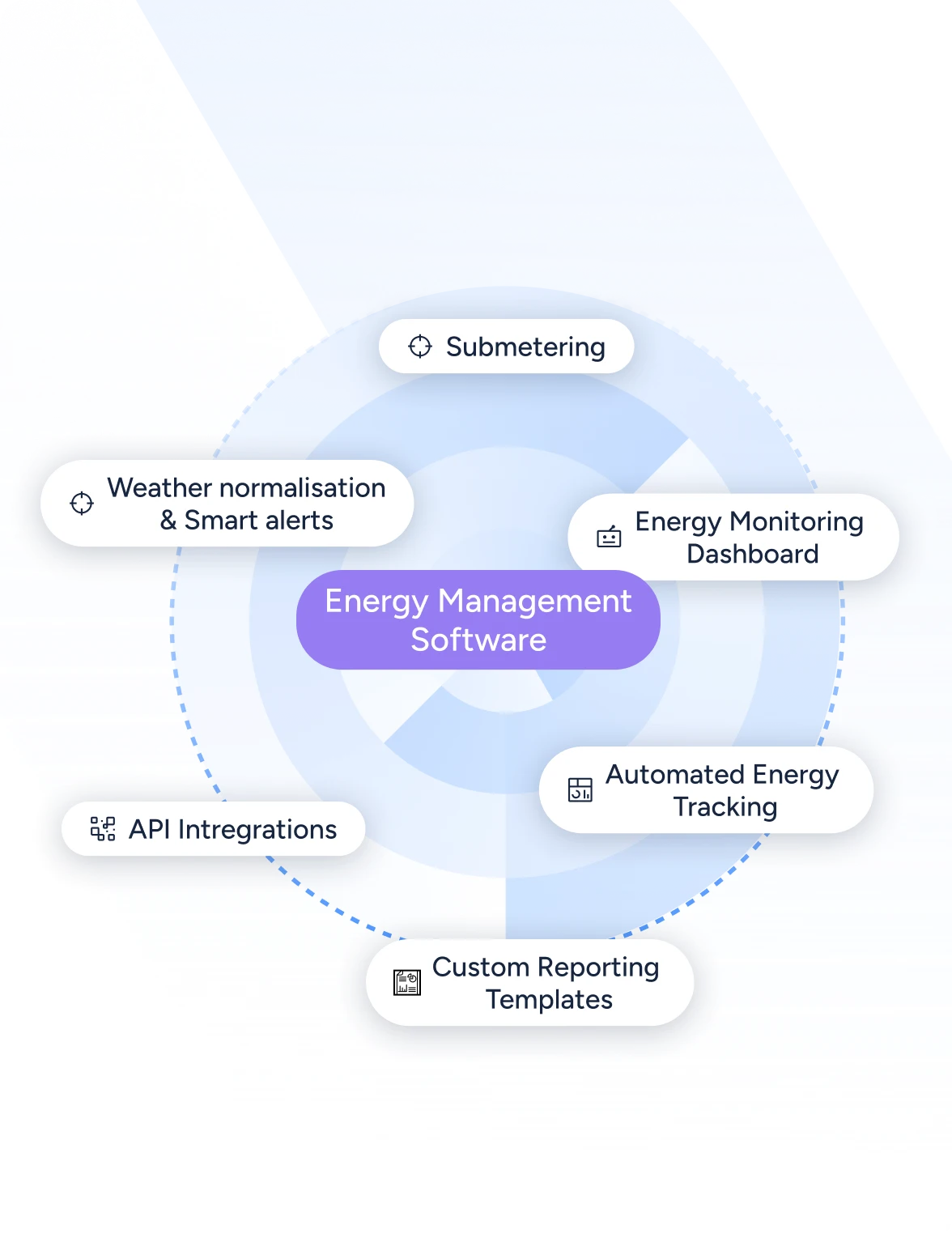
PI integrations with existing systems
The most effective management software doesn’t work in isolation. Through API integrations, EMS platforms connect seamlessly with your existing tools:
- BMS (Building Management Systems) for control and automation
- IoT platforms for granular sensor data
- ESG reporting tools for compliance-ready data transfer
Customizable reporting templates
Reporting can easily become a timely task, especially with multiple frameworks like CSRD, GRESB, and LEED to comply with. Customizable reporting templates solve that problem.
They allow energy managers to create branded, audit-ready reports that reflect company KPIs, sustainability initiatives, and carbon emissions performance.
Together, these features transform energy management software from a monitoring tool into a full-scale optimization platform. One that helps companies cut costs, improve energy efficiency, and achieve verifiable sustainability results, all from one unified interface.
The different types of energy management solutions
Not all energy management solutions are built and work the same. The right system depends on your infrastructure, data needs, and operational goals. From large industrial plants to multi‑site real estate portfolios, each environment requires a tailored mix of monitoring, analytics, and control.
Below, we’ll explore the main types of energy management software: from centralized SaaS platforms to BMS‑integrated systems. We distinguish how they serve different sectors, including residential, commercial, and industrial facilities.
Energy monitoring software
Energy monitoring software is the lighter end of the spectrum. Its main job is visibility. Real-time dashboards, consumption tracking, and basic alerts. It answers one question: what is happening right now?
Monitoring platforms are a practical first step for teams that have never had live data. They expose waste, establish baselines, and build the case for further investment.
But monitoring alone has limits. Most monitoring tools stop at the dashboard. They do not validate data quality, integrate with ESG frameworks, or support portfolio-wide benchmarking across countries and utility types.
As compliance demands grow, from CSRD to GRESB to BREEAM, organisations typically outgrow monitoring-only tools. They need a full energy management solution that handles data capture, validation, and automated reporting across their entire portfolio.
Centralized SaaS platforms vs. On‑premise systems
Most organizations today choose cloud‑based (SaaS) energy management software because it offers real‑time monitoring, scalability, and accessibility from anywhere.
A SaaS power management system collects data from meters, IoT sensors, and submeters across sites, then processes it in a centralized cloud environment.
Facility and energy managers can log in through a web dashboard to track energy consumption, generate reports, and receive alerts in real time.
Key advantages include:
- Automatic updates and new feature rollouts without IT intervention
- Centralized data storage, ideal for multi‑site portfolios
- Lower upfront costs compared to hardware‑heavy on‑premise systems
On‑premise solutions, on the other hand, are typically chosen by industrial facilities or organizations with strict security requirements. These systems run locally on company servers, offering tighter control but requiring more maintenance, hardware, and IT oversight.
Building energy management systems (BEMS)
A building energy management system (BEMS) focuses on individual building performance. It typically connects to the building management system (BMS) and pulls data from HVAC, lighting, and occupancy systems into energy analytics dashboards.
Where a general energy management platform looks at portfolio-wide trends, a BEMS zooms in. Energy intensity per m². System-level load profiles. Equipment scheduling per zone.
For teams already running a BMS, a BEMS adds the analytics layer that turns operational data into energy insights. But most traditional BMS platforms were built for comfort, not compliance. They log data in 15-minute blocks, miss gaps, and lack the traceability ESG frameworks demand.
That is where platforms like nanoGrid fill the gap. We do not replace your BMS. We add minute-level utility data that completes it.
Residential vs. industrial energy management software
The use cases for energy management software differ dramatically between households and multi asset companies.
- Residential energy management focuses on monitoring household appliances, smart thermostats, and solar production. These platforms help homeowners understand their energy usage patterns, track utility bills, and reduce energy waste.
- Commercial and industrial energy management platforms go much deeper. They aggregate energy data from thousands of devices, analyze loads at circuit level, and enable precise optimization across HVAC, lighting, and machinery.
In industrial facilities, a robust power management system can help track performance across production lines, identify equipment inefficiencies, and prevent costly downtime through predictive alerts.
Whether it’s a retail chain tracking store performance or a manufacturer balancing multiple production sites, enterprise‑grade EMS platforms are key to improving both facility management and long‑term operational savings.
BMS‑integrated vs. Standalone platforms
Energy management systems can either operate independently or integrate with Building Management Systems (BMS) to create a unified energy and control environment.
- BMS‑integrated platforms merge real‑time control (lighting, HVAC, ventilation) with energy analytics.
- Standalone EMS platforms, like nanoGrid, focus exclusively on utility‑level visibility and traceable data. They can connect to any existing meter or sensor infrastructure, making them ideal for portfolios with mixed building types or older assets. These platforms often serve as the data backbone for sustainability and reporting tools.
Examples of energy monitoring systems
Today’s energy monitoring systems range from plug‑and‑play IoT devices to enterprise‑scale analytics suites. Common examples include:
- Schneider Electric EcoStruxure Power Monitoring Expert: combines electrical distribution analytics with sustainability reporting.
- Siemens Desigo CC: integrates energy tracking within broader building automation.
- nanoGrid: a non‑invasive technologies that captures and visualizes utility data in real time and automates ESG‑ready reporting across portfolios. Their technology consits of in-house developed hardware and software.
- EnergyCAP: popular in universities and government facilities for bill tracking and benchmarking.
Each solution serves different needs, but they all share the same purpose: to help identify inefficiencies, reduce energy costs, and optimize consumption through data‑driven insights.
Benefits of Energy Management Software
Implementing energy management software is no longer just a nice-to-have. It’s a strategic investment that delivers tangible benefits across financial, operational, and environmental dimensions.
Looking for a deeper insight? Explore our article about the benefits of energy management software.
Here’s how energy managers and organizations are gaining value every day:
1. Reduce Energy Costs and Improve Operational Efficiency
At its core, energy management software is designed to track and reduce energy consumption. By providing visibility into how and where energy is used: down to the circuit, load, or time of day. It empowers energy managers to take targeted action.
Common savings come from:
- Adjusting HVAC schedules to match occupancy
- Turning off idle equipment or lighting in unoccupied zones
- Identifying energy waste due to faulty devices or misconfigured systems
Many organizations report double-digit reductions in energy costs within months of deploying a robust energy management platform. The key? Not just seeing the data, but using it to optimize energy consumption daily.
2. Real-Time Data for Better Decisions
Unlike traditional monthly utility bills that show historical trends, real-time monitoring tools offer live energy data often down to the minute. This granularity allows facility managers and sustainability teams to:
- Spot anomalies immediately (e.g., sudden energy spikes or system failures)
- Respond quickly with corrective actions
- Compare actual usage against expected baselines
3. Identify Inefficiencies and Reduce Waste
Most buildings operate with a degree of hidden waste from overcooling certain zones to leaving equipment running overnight. Energy analytics tools in energy management software are designed to expose those blind spots.
Key features like submetering, load disaggregation, and historical data comparison allow you to:
- Break down usage by equipment or system
- Spot underperforming assets
- Track maintenance issues that cause excess draw
- Uncover usage patterns that lead to cost saving opportunities
When combined with alerts and recommendations, these tools not only reduce waste. They also streamline team workflows and help allocate resources where they’ll have the most impact.
4. Track Emissions and Align with ESG Goals
Sustainability initiatives are becoming compliance requirements. Frameworks like CSRD, GRESB, and LEED demand detailed, auditable emissions data and this is where energy management software plays a central role.
Advanced platforms help you:
- Calculate carbon emissions and greenhouse gas equivalents
- Align with sustainability goals using dynamic benchmarks
- Automate ESG reports and compliance submissions
- Connect energy usage with broader environmental sustainability strategies
5. Enable Businesses to Drive Sustainability
Beyond energy savings, modern software tools help organizations take a broader view of sustainability. They connect energy initiatives with cost control, performance benchmarking, and even stakeholder communication.
Benefits include:
- Visual dashboards that engage occupants and promote awareness
- Detailed reports to inform board-level strategy
- Data-driven decisions across operations, procurement, and investment
Read a more in-depth view about the benefits of energy management software.
Final Thoughts: Managing Energy Smarter
Energy management software is no longer a nice-to-have. In 2026, it’s the foundation for achieving measurable impact, across energy efficiency, cost reduction, regulatory compliance, and ESG performance. Whether you’re a sustainability officer, energy manager, or facility operator, the message is clear: visibility powers action.
Today’s business landscape demands more than just low utility bills or vague CO₂ estimates. Investors, regulators, and tenants expect traceable, real-time data that proves your energy-saving measures work and that your carbon footprint is shrinking.
That’s why leading companies across commercial real estate, logistics, retail, and manufacturing are turning to energy management software platforms that combine:
- Real-time energy monitoring
- Minute-level utility data
- Automated ESG reporting
- Seamless integration with existing systems
And that’s exactly where nanoGrid fits in.
Frequently asked questions
Can I Test My House to See What’s Using Electricity?
Yes and you don’t need an industrial setup to do it.
For residential users, plug-in energy monitors (like Kill A Watt) or whole-home power management systems can help track where energy is being used. These tools monitor appliances, lights, and HVAC systems to detect patterns or unexpected spikes in energy consumption.
More advanced smart energy monitoring systems provide real-time data on individual circuits and even appliance-level usage through load disaggregation. These insights can help reduce energy costs, improve efficiency, and detect faulty devices.
If you’re managing a larger site, explore platforms like nanoGrid that use submetering and non-invasive hardware to identify hidden loads without disrupting operations.
How Much Does Energy Management Software Cost?
Pricing depends on your scale and needs.
Most energy management platforms operate on a SaaS model, charging based on:
- Number of monitored sites or meters
- Required data resolution (e.g., hourly vs. minute-level)
- Features (reporting, alerting, analytics, integrations)
- Support and onboarding services
Entry-level platforms for single-site monitoring may cost a few hundred euros per year. Enterprise-grade solutions for commercial buildings and portfolios with ESG reporting typically range from €5,000 to €50,000+ annually, depending on complexity.
Some vendors offer tiered pricing or modular features, allowing you to scale with your needs. When comparing costs, be sure to factor in:
- Hardware (sensors, gateways)
- Implementation time
- Ongoing support or SLA agreements
What Is the Best Way to Monitor Energy Usage?
The best way to monitor energy usage combines accuracy, granularity, and accessibility. That means:
- Real-time monitoring using submeters or IoT sensors
- Centralized dashboards to visualize and filter usage data
- Alerts to detect abnormalities or track energy maintenance issues
- Export-ready reports for utility bills, audits, or ESG frameworks
The most efficient approach integrates energy monitoring software with your operational systems (BMS, ERP, or cloud tools), so insights don’t stay locked in spreadsheets.
For homeowners: smart plugs or home energy monitors provide basic tracking.
For businesses: platforms like nanoGrid offer full-stack visibility across utilities — ideal for industrial facilities, large portfolios, and facility management teams.