Real Estate Energy Management: How software is reshaping buildings, Budgets, and ESG goals

Energy bills used to be simple: paid monthly, filed away, forgotten. Not anymore. Property owners and managers now face pressure from every angle: tenants demanding transparency, investors tracking ESG performance, regulators tightening compliance rules.
Across Europe, buildings are responsible for around 40% of energy use and roughly a third of greenhouse gas emissions, putting real estate directly in the crosshairs of climate and ESG regulation (source: Ramboll).
Globally, building operations use a large share of the world’s energy and cause more than a quarter of energy- and process-related CO₂ emissions. That means utilities are no longer just another anonymous cost line (source: IEA / GlobalABC).
The traditional methods can't keep up. Monthly invoices won't catch HVAC running overnight or lighting left on across empty floors.
Real estate energy management software turns that blind spot into real-time visibility helping property teams cut costs, meet CSRD requirements, and benchmark performance across entire portfolios.
This article provides deeper insight into what real estate energy management is and how it works in practice.
Why real estate needs smarter energy management
Energy bills have long been treated as a cost of doing business. Paid monthly, reviewed occasionally, and bundled under “utilities” in the P&L.
But in today’s real estate landscape, typified by: thight margins, stricter ESG frameworks, and more demanding tenants, that model no longer holds up.
Pressure is mounting from all sides
For property owners and property managers, expectations have shifted. Tenants want transparency. Boards want ESG progress. Investors want cost control and portfolio resilience. Add in higher energy costs and new regulations, and suddenly energy management isn’t optional. It’s becoming more strategic.
Energy consumption in commercial buildings accounts for a major share of operational costs, but those costs often go unchecked.
Why?
Because traditional tracking methods (monthly invoices, annual audits) offer no real insight into what’s actually happening inside your buildings. They lag. They generalize. They hide inefficiencies. And they certainly don’t help with regulatory compliance.
Even today, many property managers still rely on historical averages or invoice estimates. But this approach leaves businesses exposed: to energy waste, tenant unhappiness, and compliance risks.
Monthly bills won’t help you catch a leak at 2 a.m.
If lighting runs overnight, or heating systems fire up before anyone arrives, you won’t spot it until the invoice hits weeks later, if at all. That’s how energy waste quietly eats into operating margins and derails ESG targets.
Modern buildings aren’t automatically efficient. In fact, older office buildings with proper controls often outperform newer properties in energy performance, simply because they’re better managed.
That’s where real estate energy management software comes in.
A new class of tools required, for a new set of challenges
Smart technologies, like nanoGrid, bridge the gap between visibility and action. They track energy use minute by minute across your entire real estate portfolio, giving property managers, operators, and owners a real-time view of electricity, gas, and water consumption. Not just per building, but per meter, zone, or tenant.
This isn’t just about data collection. It’s also about turning that data into insights, decisions, and measurable results. Property teams get notified when something’s off. Occupants see their own usage. Owners get audit-ready data that feeds directly into ESG platforms. Everyone works from the same source of truth.
Real estate energy management has become the foundation for smarter, more sustainable, and more profitable buildings. And the shift has only just begun.

What Is Real Estate Energy Management Software?
Real estate energy management software is a digital platform designed to help property owners and property managers monitor, track, and optimise energy use. But this isn’t just about energy. It’s about control, cost, compliance, and collaboration, all in one interface.
Making energy part of real estate operations
In commercial real estate management, energy is no longer siloed under ‘technical services’ or left entirely to facility teams. It touches everything from OPEX and sustainability performance to tenant engagement and leasing conversations.
That’s why smart energy management now plays a central role in modern property operations.
Instead of chasing down bills or manually compiling reports, energy management platforms automatically collect and process data from across your property portfolio.
This includes:
- Real-time consumption from meters and submeters
- Alerts on anomalies or spikes
- Audit-ready carbon and emissions reports
- Custom dashboards for tenants, facility managers, and ESG leads
Supporting both owners and operators
For property owners, the value lies in visibility and reporting. They need to know which buildings underperform, how they benchmark against industry standards, and whether their assets align with CSRD, GRESB, and net-zero goals.
For property management teams, the software reduces daily friction. It replaces fragmented data collection with one central source. Facility managers can detect issues early, plan maintenance better, and prove the impact of their actions.
In both cases, energy management becomes proactive not reactive. Above all, when linked to broader property management systems. It helps streamline workflows across rent collection, maintenance, ESG, and performance tracking.
More than just software, it’s infrastructure
True energy management doesn’t live in a silo. That’s why leading commercial real estate management platforms now integrate energy tools directly into their core stack.
From building performance to tenant billing and sustainability audits, it’s all part of the same data loop.
For real estate teams aiming to future-proof their assets, energy management isn’t just a feature. It’s a fundamental building block.
The top 8 benefits for property owners and managers
Smart energy management isn’t just about data. It’s about better decisions, smoother operations, and stronger assets.
Here’s how property owners and property managers benefit when energy is tracked and managed in real time:
1. Reduce operational costs
As mentioned before, energy is one of the largest controllable expenses in commercial buildings. By identifying inefficiencies and reducing waste, property teams can cut costs without compromising comfort.
2. Improve energy efficiency in commercial buildings
Whether it’s HVAC, lighting, or base load consumption, energy management platforms help monitor performance and optimise settings.
The result? Lower energy use and better building efficiency scores.
3. Boost ESG scores and compliance
As CSRD, GRESB, and LEED requirements tighten, compliance has shifted from optional to essential. Energy management software streamlines this process through traceable data, real-time dashboards, and export-ready templates.
Beyond just simplifying reporting, granular energy data directly strengthens your GRESB score making your asset portfolio more attractive to ESG-focused investors.
4. Enhance tenant comfort
Tenants expect comfortable, well-run buildings. Real-time energy insights help property managers adjust systems for better indoor air quality, lighting, and temperature control. While not overspending on utilities.
5. Centralize data across portfolios
Stop chasing spreadsheets. Property managers gain a single interface for energy, carbon, and cost data across every site and building. This means less manual work and more time for strategic planning.
6. Streamline maintenance with real-time alerts
When a chiller runs too long or a lighting system fails to shut off, the system flags it instantly. Maintenance teams can fix issues before they turn into bills or complaints.
7. Enable smarter CAPEX planning
Energy insights reveal which assets perform and which don’t.
That makes it easier to justify upgrades, prioritise investments, and plan retrofits that truly move the needle.
8. Add property value and portfolio resilience
Efficient, well-managed buildings attract better tenants, qualify for green financing, and hold their value. In today’s market, energy management is a direct driver of long-term asset resilience.
How it “can” work: From utility data to portfolio insights
Real estate energy management goes beyond tracking electricity. It transforms fragmented utility data into actionable insights at the floor, building, or portfolio level.
Real-time submetering and data collection
At the heart of it is data. Smart submeters capture electricity, gas, water, and heat usage minute by minute, across every utility and tenant zone. This high-resolution data collection gives property managers visibility into where energy is used and therefore where it’s wasted.

Energy dashboards, alerts, and automation
Once collected, this data is visualised in central dashboards. From automated alerts for anomalies to AI-driven forecasts, managers can react in real time or set up rules that automate responses across their buildings.
No more waiting for end-of-month utility bills to spot problems.
Seamless integration with smart meters, BMS, and ERP tools
The best platforms don't replace what's already working, they build on it. Whether you rely on building management systems (BMS), ERP software, or smart meter networks, energy management solutions integrate across systems to deliver a unified view of energy and utility data.
With the right setup, you don’t just collect data, you create clarity.
Real estate use cases: offices, retail, and industrial sites
Energy consumption in commercial buildings isn’t uniform. Different property types come with different challenges and opportunities. Understanding these patterns is the first step to better energy outcomes.
What consumes the most energy in commercial buildings?
In office buildings, HVAC and lighting account for up to 70% of total electricity use. In retail and logistics parks, the picture changes: refrigeration, ventilation, and equipment loads often take the lead.
Without granular data, these high-consumption systems can quietly drain budgets.
Patterns in multi-tenant buildings, logistics parks, and offices
Multi-tenant properties bring added complexity: variable occupancy, overlapping usage, and shared utilities. For property managers, this means uneven consumption across spaces and time. Retail centres face seasonal peaks.
Warehouses may operate 24/7 in one zone but sit idle in another.
Smart energy management makes these patterns visible. It helps property managers track by tenant, floor, or asset. So there is fair tenant rebilling, detect inefficiencies, and adapt operations in real time.
nanoGrid in action: cross-site benchmarks and loss detection
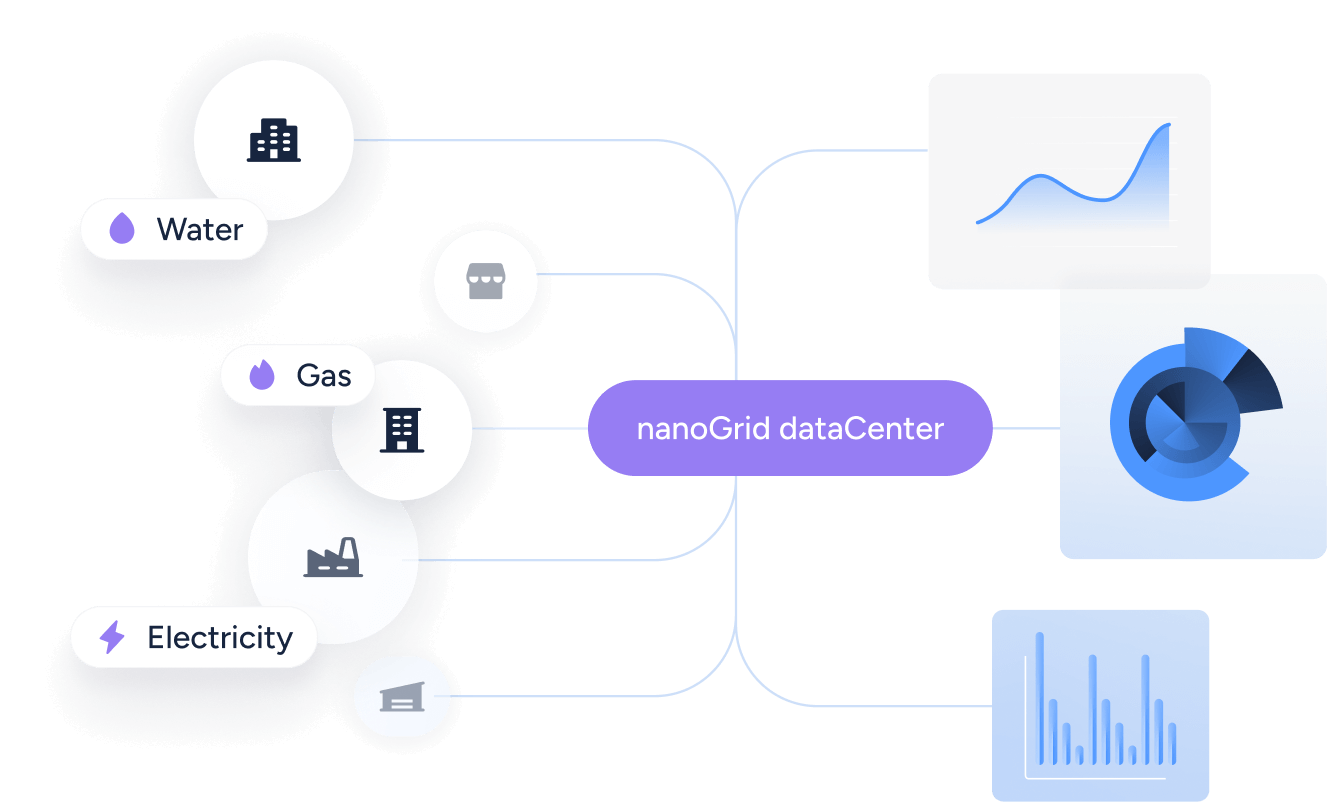
With nanoGrid, portfolio owners can benchmark electricity and gas usage across dozens or hundreds of buildings across Europe.
In one logistics park, a sudden spike in nighttime consumption revealed a misconfigured lighting schedule. In an office complex, nanoGrid’s real-time data flagged a heating system running outside occupancy hours.
From loss detection to energy budgeting, nanoGrid helps property teams transform blind spots into measurable savings, backed by the most accurate data on the market.
ESG and compliance: What will the industry demand in 2025?
Real estate no longer gets a pass on carbon reporting. In 2025 and beyond, commercial buildings will face rising expectations from regulators, investors, and tenants.
The message is clear: prove your environmental performance or risk falling behind.
From CSRD to GRESB: What’s required
The Corporate Sustainability Reporting Directive (CSRD) mandates detailed energy and emissions disclosures from large companies across the EU, even timestamped.
Meanwhile, GRESB scores directly influence investment flows and asset valuation. Certifications like LEED, BREEAM, and WELL increasingly drive leasing demand and lower risk premiums.
Beyond these frameworks, local regulations add another layer many cities now require annual energy reporting or impose emissions caps on commercial buildings.

Auditable data, down to tenant level
Regulatory compliance demands traceable energy consumption data not estimates. Property managers must provide usage metrics at the building and tenant level, backed by audit-ready records. Legacy spreadsheets and monthly utility bills can’t deliver that.
Why minute-level evidence matters
Monthly totals can’t reveal leaks, inefficiencies, or scheduling issues.
But minute-level submetering can. It captures real-time behavior, helping you prove actual reductions and meet both carbon footprint goals and compliance needs.
Final Thoughts: Better buildings start with better data
As the real estate sector faces growing demands for ESG/CSRD alignment (maybe now slightly held back by COP30), regulatory transparency, and cost control, energy management is no longer a nice-to-have.
It’s the foundation for running smarter, more resilient portfolios.
Today, property owners and asset teams need more than annual audits and utility summaries. They need real-time, auditable energy data that reflects how buildings actually perform: minute by minute, meter by meter.
This is where modern energy management platforms deliver value. By connecting submetering, automation, and reporting into one system, they unlock sharper insights, higher efficiency, and measurable sustainability gains.
Beyond compliance, the right software preserves property value, strengthens tenant relationships, and guides smarter decisions across your portfolio.
At nanoGrid, we make energy insight effortless: regardless of your existing meters, systems, or setup.
Better data means better buildings.
See how nanoGrid delivers real-time energy intelligence across all your sites. Schedule a demo or speak with our team.