Top 8 Benefits of Energy Management Software: How It Helps Reduce Business Costs

Energy costs are rising, and the benefits of energy management software are no longer a luxury. They’re essential for staying competitive.
In 2025, businesses faced utility bill increases averaging 10–15% across Europe (source: Statista) with inefficient energy use responsible for up to 30% of avoidable operating costs (source: European Commission).
The latest studies show that organisations using modern management platforms have cut total consumption by as much as 15% (source: Statista) simply by turning real-time data into action.
In this article, discover how smart energy software gives you control, clarity, and measurable savings, right from day one.
1. Real-time energy monitoring for smarter decisions
Most businesses only realise how much energy they’re wasting when the utility invoice arrives and by then, it’s too late to fix it.
Real-time energy monitoring changes that process.
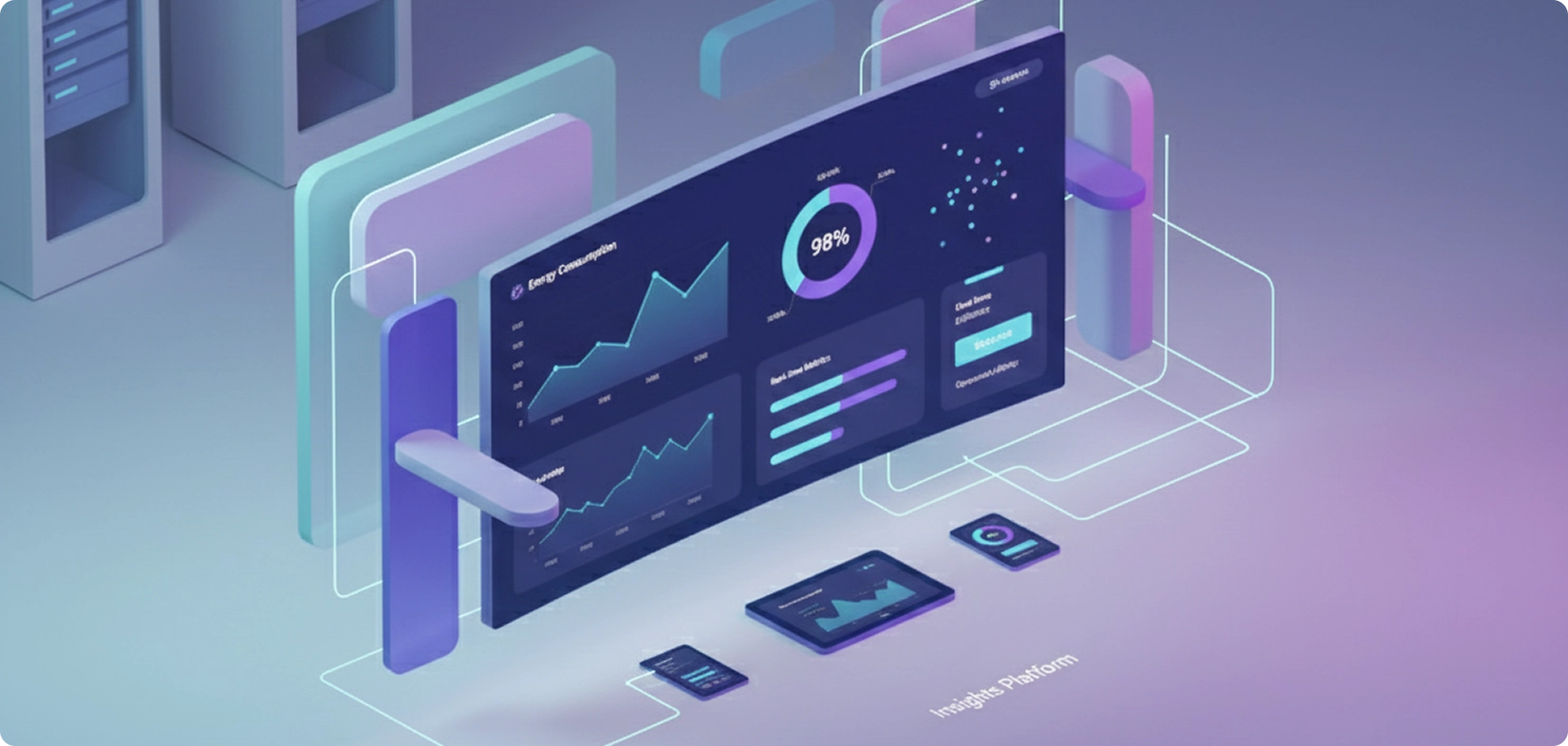
With modern energy monitoring software, facility and energy managers gain live, granular visibility into how, when, and where energy is used across their buildings.
Instead of relying on monthly invoice estimates or delayed meter reads, you get live data down to the circuit, room, or asset level.
This is the core value of real-time energy tracking: it gives organisations the insight and reaction time needed to identify inefficiencies before they turn into costs. Lights left on after hours, HVAC overuse in unoccupied zones, equipment running in standby mode. All of it becomes visible and measurable in a matter of minutes, not months.
From static data to live insights
Traditional systems rely on aggregated readings or invoice summaries that hides anomalies and patterns. In contrast, energy monitoring software like nanoGrid’s gives you access to high-resolution energy data that can be visualised in dashboards, alerts, and reports with timestamps to back every kilowatt-hour.
Whether you’re tracking a single warehouse or hundreds of tenant locations, this level of visibility allows energy managers to:
- Spot unexpected usage surges or load spikes
- Compare energy usage across zones or time periods
- Monitor real-time impact of manual overrides or control strategies
- Investigate abnormal utility bills before they’re paid
The result isn’t just better reporting. It’s better decision-making. Teams can prioritise interventions where they have the highest ROI, test energy-saving initiatives in real time, and justify upgrades based on actual performance rather than assumptions.
The business case is immediate
Real-time monitoring isn’t just a technical upgrade, it’s a business advantage. Companies that implement real-time energy tracking report faster responses to equipment failures, lower utility bills, and significant reductions in energy waste across their portfolios.
In fact, studies show that organisations using live monitoring platforms can cut up to 15% of their total energy consumption, simply by identifying inefficiencies that would otherwise go unnoticed.
And because nanoGrid’s technology integrates easily with existing meters, BMS, or submeters, the path to visibility doesn’t require a full infrastructure upgrade.
2. Cost savings through granular data and optimization
Most businesses don’t have an energy problem, they have a visibility problem.
Without accurate insight into when and where energy consumption happens, controlling costs becomes guesswork. That’s where granular energy data changes the game.
With energy management software, you can optimize energy consumption in real time, not just monitor it after the fact. Every data point collected helps your team make smarter operational decisions that directly reduce energy costs.
From energy data to measurable savings
Granular data gives facility and energy managers the power to zoom in on usage patterns down to the zone, floor, or even individual asset. By analysing that detail, you can:
- Shift loads away from peak price hours
- Identify equipment running unnecessarily
- Detect high base loads during downtime
- Uncover energy-intensive behaviors in specific departments or processes
These insights are key to cutting hidden costs and they compound over time. One misconfigured HVAC unit running 24/7 can increase your utility bill by thousands each year. Spot it early, and the fix is often simple.
Use case: Load shifting and demand response
Let’s say your business operates in a region with dynamic pricing or time-of-use energy rates. Through real-time energy monitoring, the software identifies when your energy demand peaks and recommends actions like:
- Rescheduling high-load processes to off-peak hours
- Charging EV fleets or running chillers overnight
- Participating in demand response programs that pay you to reduce usage during grid strain
This is energy optimization in action: a smart, proactive approach that balances comfort and performance with cost savings.
The ROI is clear
In most commercial buildings, inefficient scheduling and unbalanced load profiles are responsible for 10–20% of total energy consumption. Fixing them doesn’t require huge retrofits it requires better data, smarter timing, and automation tools that respond in real time.
That’s exactly what modern energy management platforms are built to deliver.
In particular by connecting nanoGrid to your existing infrastructure, your team can optimize energy consumption portfolio-wide and unlock cost-cutting opportunities hidden down to your everyday operations.
3. Automated reporting for compliance and ESG alignment
As regulations tighten across Europe and beyond, energy reporting is no longer optional, it’s essential. From GRESB benchmarks and CSRD audits to LEED certifications and internal ESG targets, companies today are expected to prove what they consume and how it impacts the planet.
And yet, too many sustainability teams still rely on spreadsheets and manual uploads to track carbon emissions data. The result? Inaccuracies, duplication, and missed deadlines.
From spreadsheets to audit-ready data
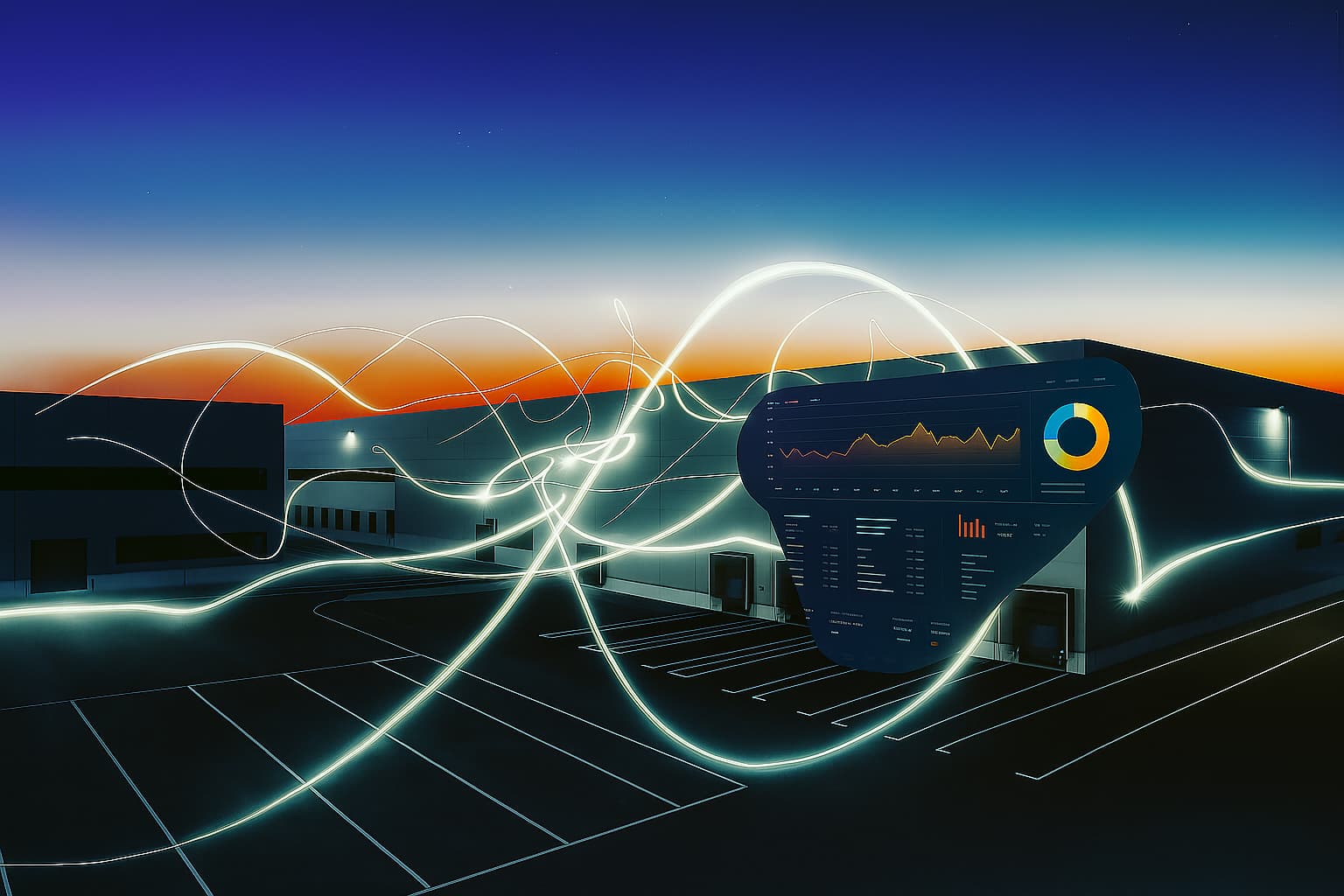
Modern energy management software replaces outdated reporting processes with automated, structured tools. These platforms collect, standardize, and format energy consumption and carbon footprint metrics directly from your utility meters and submeters. No more back-and-forth with accounting or requesting data from building ops.
The result: audit-ready exports, traceable energy data, and a single source of truth across your organization.
Aligning with global ESG frameworks
Top-tier platforms like nanoGrid are built to align with leading regulatory and certification systems, including:
- CSRD: Supports traceable, time-stamped environmental disclosures
- GRESB: Simplifies scoring with pre-mapped KPIs
- LEED & BREEAM: Integrates with building certifications through automated data feeds
- EPRA, SFDR, CRREM: Enables standardized emissions disclosures and decarbonization tracking
This level of alignment helps reduce reporting workload, improves accuracy, and ensures your team is always one step ahead of compliance deadlines.
ESG benefits for both owners and tenants
Clear, automated energy reporting benefits both sides of the real estate market:
- Owners can track building performance across entire portfolios, compare assets, and measure progress against ESG and company-wide sustainability goals.
- Tenants gain visibility into their own carbon footprint, can request reports for investor communications, and demonstrate participation in broader environmental impact efforts
4. Energy analytics for forecasting and better procurement
Energy costs don’t just depend on how much you consume. They’re about when you use it and how smartly you buy. That’s where energy analytics make the difference.
Modern energy management software doesn’t stop at tracking current usage. It applies advanced algorithms to your historical data, local weather forecasts, and utility data to surface predictive insights.
This is the backbone of smarter energy procurement strategy.
Forecasting energy demand with precision
By analysing past energy consumption trends and overlaying them with seasonal and meteorological data (metadata), predictive models help companies forecast future energy demand with a high degree of accuracy. These forecasts are crucial for:
- Anticipating peak load events
- Planning energy saving initiatives
- Understanding how external conditions (temperature swings, heating/cooling needs) impact overall utility data and load profiles
Smarter contracts. Lower risk.
Predictive analytics also directly support smarter energy contracts. Instead of locking into static rates based on assumptions, organizations can:
- Benchmark procurement choices against real usage patterns
- Shift toward dynamic or hybrid contracts with confidence
- Reduce exposure to price fluctuations by aligning purchasing with accurate forecasts
The result? Lower risk. Fewer overages. And more stable energy budgets across your portfolio.
Turning analytics into real savings
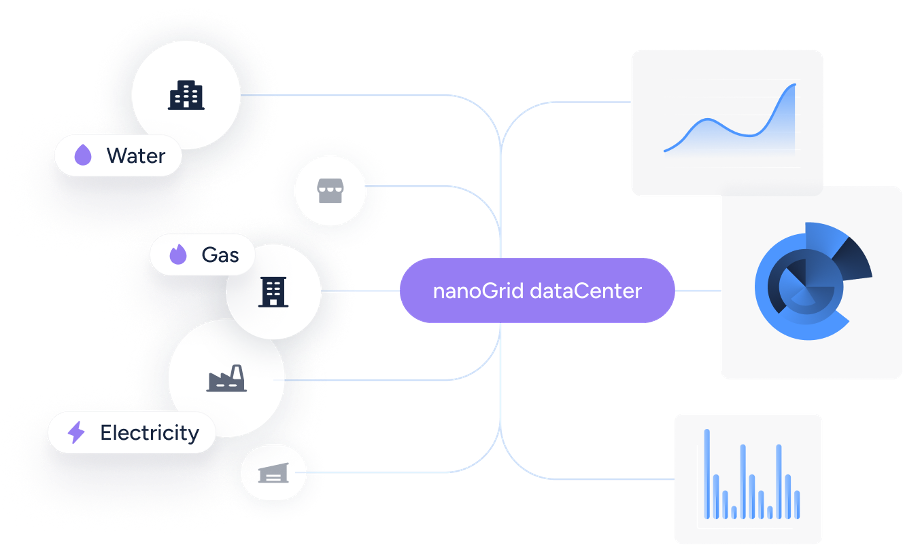
All of this only works if the data collection behind it is reliable and granular. nanoGrid enables this by capturing high-resolution utility data: broken down by site, zone, and countries. It’s this clarity that powers predictive models and helps procurement teams:
- Optimize timing for contract renewals
- Model impact of switching energy sources
- Compare supplier offers based on real performance
5. Identify inefficiencies and drive maintenance improvements
Even the most advanced buildings hide operational inefficiencies. Equipment that runs after hours. Leaking valves that go unnoticed. HVAC systems misconfigured for empty spaces. Without real-time visibility, these issues silently drive up your utility bill month after month.
That’s where modern energy management software comes in.
Spot inefficiencies before they escalate
When having an energy monitoring software, facility and energy managers can identify inefficiencies the moment they happen.
Your platform continuously tracks energy consumption data and flags anomalies in real time. It can uncover issues such as:
- Lighting or ventilation running outside scheduled hours
- Hidden loads from faulty or miswired equipment
- Zones consuming far more energy than expected
This data goes beyond showing how much energy you use. It reveals where, when, and why inefficiencies occur.
Real-time alerts = faster fixes
Modern technologies like nanoGrid do more than visualize data. They alert you the moment something’s off. Whether it’s a compressor stuck on or a fan running nonstop, real-time triggers help you:
- Detect maintenance issues instantly
- Send technicians before performance drops
- Prevent tenant complaints and unexpected downtime
Smart alerts also cut the need for manual checks and audits, saving time and reducing operational costs.
6. Empower you sustainability department with auditable data
For sustainability teams, ambition isn’t the issue, evidence is.
Whether you’re tracking building-level carbon emissions, reporting under CSRD, ESG, or trying to meet corporate sustainability goals, you need more than yearly estimates. You need accurate, continuous data that’s easy to access and audit.
That’s exactly what modern energy management software delivers.
One source of truth across your energy portfolio
Instead of switching between spreadsheets, invoices, and third-party reports. Sustainability teams get a centralised dashboard that pulls everything into one place.
From here, they can:
- Monitor energy usage and emissions per site, country, tenant, asset, ...
- Compare performance across the full energy portfolio
- Export data aligned with regulatory and ESG standards
- Share real-time performance insights with stakeholders
Turning data into actionable insights
Beyond compliance, the real benefit is alignment. When energy management software puts auditable data in the hands of your sustainability leads, they can:
- Set smarter goals
- Track progress in real time
- Justify sustainability initiatives internally
- Confidently communicate results externally
And that’s not just good for compliance. It’s good for reputation, investment, and the planet.
7. Enable renewable energy integration and load balancing
Modern energy management software doesn’t just track usage. It can help you manage how renewable energy sources interact with your total load.
Whether you’re operating solar panels on a logistics site, heat pumps in a retail unit, or EV charging stations across a property portfolio, the key challenge is the same:
How do you balance what’s produced, what’s consumed, and what’s wasted?
That’s where real-time visibility makes the difference.
One platform to track all energy sources
With the right management software, you get a full overview of your energy sources, including renewables, and how they support or offset grid demand. Energy managers can track:
- Solar yield throughout the day
- Heat pump output per site
- Self-consumption ratios
- When energy is exported to the grid via net metering
All in one centralized dashboard that makes energy flows transparent and actionable.

8. Improve operational efficiency across multi-site portfolios
Managing energy in one building is complex.
Managing it across dozens or even hundreds of locations?
That’s where real estate energy management software becomes essential.
For real estate owners, asset managers, and facility teams, operational consistency across portfolios is a challenge. Different sites have different systems, usage patterns, climates and often, even different levels of visibility.
Modern energy management software solves this with one centralized platform that lets you monitor, compare, and improve performance across your entire portfolio.
Benchmark and optimise across sites
With smart meters and real-time data streams, you can:
- Compare energy consumption across similar buildings
- Spot underperforming assets in seconds
- Apply energy savings strategies proven to work at one site across others
- Flag anomalies, leaks, or faulty equipment before they become costly
Seamless integration with your existing stack
Good energy monitoring software doesn’t require ripping and replacing what you already have. It integrates seamlessly with:
- Building Management Systems (BMS)
- Smart meters and submeters
- ERP platforms and internal data lakes (e.g. API integrations)
- IoT sensors already deployed on-site
This flexibility means you can monitor and control energy usage without disruption and build on your existing infrastructure instead of duplicating it (retrofit).
From fragmented to future-ready data
Fragmented data holds progress back. With nanoGrid, you can centralize energy insights, standardize reporting, and give every site manager access to the same live data. Down to each meter or asset.
Instead of just fixing problems as they appear, this helps you plan ahead and optimize your energy use strategically. It connects your separate systems into one centralised tool, creating a real, positive impact across your entire property portfolio.
Final thoughts: energy insight is competitive advantage
For 2025 and beyond, energy isn’t just a line item on your utility bill. It’s a strategic advantage.
Energy management software has evolved from a nice-to-have tool into a core enabler of operational resilience, cost control, and carbon transparency.
For energy managers, facility teams, and sustainability leads, gaining real-time visibility into energy usage, automating reporting, and identifying inefficiencies are no longer optional. They’re the baseline.
The benefits of energy management software go beyond utility invoices or dashboards. It gives you:
- Clarity over your energy portfolio
- Control over energy consumption and operational costs
- Proof of performance for ESG and carbon reporting
- The flexibility to scale across regions and building types
And most of all, it turns scattered energy data into actionable insight: helping you reduce waste, unlock savings, and meet your sustainability goals with confidence.
nanoGrid delivers exactly that:
A non-invasive, future-proof technology that empowers you to monitor, report, and optimise energy at scale, without replacing your existing systems.
Interested in learning more about nanoGrid? Contact us and we will be in touch.