Energy Efficiency Directive: What It Requires, Who It Hits, and Why Starting Now Is Already Late

The revised energy efficiency directive (EU/2023/1791) rewrites the rules for energy management across Europe. It no longer matters how many people your organisation employs. What matters is how much energy your buildings consume.
By 2030, the EU must cut final energy consumption to 763 Mtoe (EUR-LEX, 2023).
That single shift in EU energy policy pulls thousands of multi-site enterprises into scope for mandatory energy audits and certified energy management systems for the first time. The deadlines are fixed: October 2026 for audits, October 2027 for ISO 50001 certification. And the compliance clock does not pause for organisations still running on invoice-based data and fragmented utility records.
This article breaks down what the EU energy efficiency directive requires, which organisations fall under its thresholds, and why the timeline is shorter than most energy managers realise. If your portfolio spans multiple European sites, this regulation will shape your energy management priorities for the next 18 months.
What the Revised Energy Efficiency Directive Changes
From Company Size to Energy Consumption
The energy efficiency directive was significantly revised in 2023 to align with the EU Green Deal package and the "Fit for 55" targets, which aim at reducing greenhouse gas emissions by at least 55% by 2030. The European Union adopted Directive 2023/1791 to replace the energy efficiency directive 2012, establishing "energy efficiency first" as a fundamental principle of EU energy policy that requires EU countries to consider energy efficiency in all relevant policy and major investment decisions.
The most consequential change: obligations now depend on consumption levels, not company size. Under the previous directive, only large enterprises had energy audit obligations. The new energy efficiency directive scraps that. A 20-person logistics operator consuming energy at 12 TJ per year is in scope. A 500-person services company at 8 TJ is not.
The directive sets binding energy efficiency targets. By 2030, overall EU energy consumption should not exceed 992.5 Mtoe for primary energy and 763 Mtoe for final energy. These national energy efficiency targets require each of the EU member states to translate the directive into concrete obligations through national law. Member States were required to transpose its provisions into national legislation by October 11, 2025. That deadline has passed.
The Annual Energy Savings Obligation
The revised directive more than doubles the annual energy savings obligation. EU member states must achieve cumulative end-use energy savings of at least 0.8% of final energy consumption in 2021-2023, increasing to 1.9% in 2028-2030. This energy savings obligation is among the most ambitious provisions in EU energy policy.
For enterprises, this creates growing pressure to demonstrate measurable energy savings. The directive mandates EU countries to collectively achieve an additional 11.7% reduction in overall EU energy consumption by 2030. National energy efficiency targets will drive stricter enforcement at every level.
To support energy efficiency investments, the directive requires EU member states to establish project development assistance mechanisms, advisory points that provide technical and financial advice, and energy performance contracts between building owners and energy service providers. The intent: remove barriers, drive energy savings, and make regulatory compliance financially viable.
Who Falls Under the Energy Efficiency Directive?
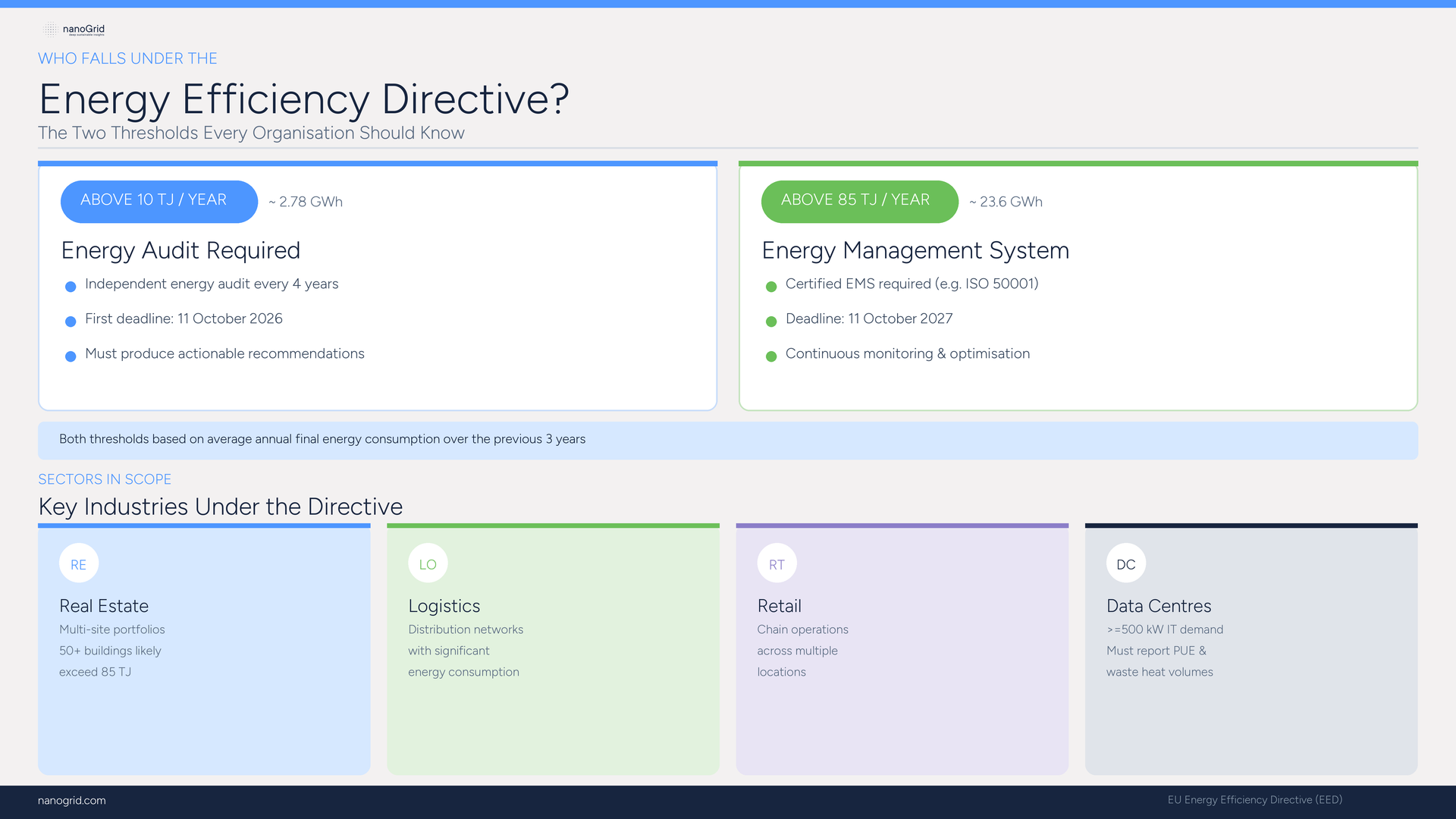
The Two Thresholds Every You Should Know
The directive introduces two energy consumption targets that determine your obligations:
- Above 10 TJ per year (approximately 2.78 GWh of final energy): Your organisation must complete an independent energy audit at least every four years. The first must be completed by 11 October 2026. Each audit must produce actionable recommendations and a concrete action plan with energy savings measures.
- Above 85 TJ per year (approximately 23.6 GWh of final energy): Your organisation must implement a certified energy management system, such as ISO 50001, by 11 October 2027. Energy management systems are mandatory for large energy consumers to monitor and optimise energy savings continuously.
Both thresholds use average annual final energy consumption over the previous three years. The directive expands scope to include all enterprises above these thresholds, including SMEs where significant energy saving potential exists. Previously, many mid-sized organisations across multiple sites were exempt. Under the new EU energy efficiency directive, they are not.
Sectors in Scope: Real Estate, Logistics, Retail, and Data Centres
Multi-site real estate portfolios, logistics networks, and retail chains are among the most likely to exceed the 85 TJ threshold. A portfolio of 50+ commercial buildings will almost certainly surpass it.
Data centres receive specific attention. Facilities with IT power demand of at least 500 kW must report energy metrics including power usage effectiveness, temperature set points, and waste heat volumes. The directive also encourages data centres to make excess heat available for efficient district heating networks and local heating systems.
Large industrial energy consumers face similar scrutiny. The directive requires energy management across all operations with significant energy consumption, pushing energy efficiency related professionals to implement structured monitoring at scale.
What Does the EU Energy Efficiency Directive Require in Practice?
Energy Audit Requirements
The directive mandates that organisations above the 10 TJ threshold conduct independent audits at least every four years. These must identify where significant energy saving potential exists, recommend specific energy efficiency measures, and quantify expected savings.
Auditors expect documented energy flows, consumption data by system and zone, and evidence of previous energy efficiency improvements. Organisations without continuous metering data will struggle. Invoice records show what you spent. Auditors need to understand why your energy intensity changed, or did not.
Energy Management Systems and ISO 50001 Certification
For organisations above 85 TJ, a certified energy management system is mandatory. ISO 50001 demands continuous monitoring, energy performance indicators (EnPIs), documented baselines, and identification of significant energy uses.
This is not a reporting exercise. Certification requires a minimum of 12 months of continuous, gap-free, meter-level data per site. Why invoice data cannot meet ISO 50001 requirements is well documented: monthly summaries cannot support the energy performance tracking auditors expect.
Understanding whatISO 50001 auditors check and how to build your evidence pack is essential. For multi-country portfolios, how implementation changes at portfolio scale introduces complexity around consistent data collection and setting defensible energy performance indicators and baselines.
The directive also promotes energy performance contracts to drive energy savings between building owners and energy service providers. These contracts depend on accurate, continuous metering data for measurement and verification.
Remote Readability and Real-Time Monitoring
All meters for thermal energy must be remotely readable by 2027. This pushes the building stock toward real-time tracking, reducing energy consumption blind spots that persist when data arrives monthly.
Continuous monitoring is the foundation for proactive energy management: catching anomalies, optimising savings, and building the auditable data trail that both ISO 50001 and ESG frameworks require.
How the Directive Stacks With Other EU Regulations
The EU energy efficiency directive does not exist in isolation. It sits alongside the CSRD, the EPBD, BACS requirements for buildings, GRESB, CRREM, and the EU emissions trading system. For portfolio managers, this creates a compliance stack where the same requirement repeats: verified, continuous energy data.
The directive extends energy renovation obligations to public buildings. The public sector must reduce total final energy consumption by at least 1.9% annually compared to 2021 levels. Public buildings larger than 250 m² must undergo energy efficiency renovations to meet minimum energy performance standards. These buildings represent roughly 2% of EU final energy use, with energy efficiency improvements showing median payback of about 7 years. The target: zero emission buildings by 2040. New buildings must be zero-emission by 2030.
One Data Layer, Many Rulebooks
Beyond buildings, the directive promotes efficient district heating with cooling plans, prioritises new heat generation capacities from renewable energy and waste heat sources, and supports high efficiency cogeneration units. It addresses future energy security through reductions in overall energy consumption and primary energy demand. EU member states must also promote local heating solutions and prioritise energy efficiency improvements for vulnerable populations.
The directive includes dedicated provisions for alleviating energy poverty. Each country must ensure a share of its energy savings obligation benefits those affected by energy poverty, with technical support and advisory services to help reduce energy consumption for affected households.
For commercial portfolios, the pattern holds. Redevco's asset management team noted that evolving regulations make it increasingly mandatory to monitor and report energy consumption. The same data infrastructure serves the energy efficiency directive, CSRD, EPBD, GRESB, and CRREM. One investment in metering satisfies multiple regulatory compliance requirements and supports overall energy consumption reduction.
Why the Timeline Is Tighter Than It Looks
Work backwards from October 2027. ISO 50001 certification takes 12 to 18 months. Before that, you need 12 months of continuous baseline data. Before that, metering hardware must be installed and validated across your sites.
The window to begin is now. Under the new energy efficiency directive, organisations with significant consumption above the threshold that have not started risk missing the deadline.
The Deadline Starts Long Before the Deadline
Complying with the directive can improve energy efficiency and deliver cost savings of up to 40% through systematic energy management. Energy efficiency investments in commercial buildings deliver clear returns. Strategic adherence positions companies as leaders in operational excellence, influencing major investment decisions and investor confidence.
At portfolio scale, compliance usually depends on reliable building-level and submeter-level data, supported by metering infrastructure that can capture consumption accurately and make it available for analysis. While the directive does not prescribe one specific technical architecture, organizations with fragmented or invoice-based data will struggle to prove performance, identify savings, or support audits and energy management systems.
Ready to Build Your EED Data Foundation?
The directive is not a future concern. The audit deadline is 18 months away. The ISO 50001 deadline is 30 months away. The metering infrastructure needed to comply takes months to install, commission, and validate.
Portfolios like WDP and Goodman chose nanoGrid because they needed energy data infrastructure they could prove to auditors, investors, and regulators. If your organisation falls under the EU energy efficiency directive's thresholds, the time to build that foundation is now.
Book a demo to assess your portfolio's readiness. Or explore how nanoGrid helps automate compliance and sustainability reporting across your entire portfolio.
Frequently Asked Questions
What is the energy efficiency directive?
The energy efficiency directive is the European Union's primary legislation for reducing energy consumption across all sectors. The revised version (EU/2023/1791) sets binding national energy efficiency targets and introduces consumption-based thresholds for energy audits and energy management systems. It forms part of Europe's energy transition strategy to reduce greenhouse gas emissions, increase renewable energy uptake, and secure future energy security.
When must enterprises comply?
EU member states transposed the directive into national law by October 2025. Enterprises above 10 TJ must complete their first audit by 11 October 2026. Those above 85 TJ must have a certified energy management system by 11 October 2027.
Does the directive apply to SMEs?
Yes. The directive no longer exempts organisations by size. Any enterprise above 10 TJ of annual energy consumption falls in scope, regardless of headcount. SMEs with significant energy consumption and energy intensity above the threshold are fully included.
What is the difference between an energy audit and an energy management system?
An energy audit is a periodic assessment (every four years) that identifies energy savings potential and produces an action plan. An energy management system is a continuous, certified framework like ISO 50001 for monitoring energy performance and driving ongoing energy efficiency improvements. The directive requires audits for the lower threshold and a full system for the higher one.
How does the directive affect data centres?
Data centres with IT power demand of at least 500 kW must report power usage effectiveness, temperature set points, and water use. The directive encourages data centres to supply waste heat for efficient district heating. These obligations make data centres among the most scrutinised sectors.
How does the directive address energy poverty?
It includes provisions for alleviating energy poverty. EU member states must prioritise energy efficiency renovations and energy efficiency measures for vulnerable households. Each country defines criteria ensuring a share of the annual energy savings obligation benefits those in energy poverty.