Invoice Data Tells You What You Spent, ISO 50001 Needs to Know Why

Every audit cycle, energy managers at multi-site portfolios face the same moment. An auditor requests 12 to 24 months of continuous, site-level energy consumption data. And they scramble.
Not because the data was never generated. Every meter generates it. They scramble because it was never collected in a way that is retrievable, consistent, or credible. The reason: managing iso 50001 on invoice data. Monthly utility bills. Totals, not time-series. Summary lines, not meter-level readings.
ISO 50001 does not accept summaries.
What ISO 50001 Actually Requires From Your Energy Data
The standard is specific. Clause 9.1 requires organisations to establish and maintain a measurement plan covering significant energy uses, relevant variables, EnPIs, and the effectiveness of action plans, at a frequency appropriate to the variability of the energy use.
For most building systems (HVAC, lighting, pumps), that means hourly or sub-hourly data. Enough granularity to detect anomalies and verify that changes made to the system actually changed consumption.
Clause 10.2 requires more. When energy performance worsens or a target is missed, the organisation must determine root cause, take corrective action, and verify effectiveness. That requires before-and-after data at the relevant meter level.
Invoice data cannot provide either. Taken together, the clauses require a continuous, granular, meter-level data record: maintained, archived, and accessible for audit. That is the implicit data standard energy management system iso 50001 sets, and most organisations running on invoices are not meeting it.
What Invoice Data Gives You, and What It Does Not
To be fair: invoices provide something useful. Total consumption per billing period, cost per unit, total cost. For annual ESG reporting and high-level budget tracking, monthly figures work.
The gaps start the moment you need anything more granular.
Invoices give you no signal of when within the billing period consumption was high or low. No insight into which system drove a change. No real-time fault detection. And no ability to verify corrective action effectiveness when a billing period spans both the before and after state of a change.
For ISO 50001, those gaps are not minor. They are the difference between a documented management system and an auditable one.
Five Failure Points Where the Gap Becomes Visible
This is where invoice-based management shows up in practice.
1. The baseline is weak and easily challenged.
ISO 50001 requires 12 months of continuous data at SEU level to establish a defensible baseline. With invoices, you have 12 monthly totals. Normalisation variables cannot be applied meaningfully to monthly aggregates. An auditor who probes the methodology will find it does not hold.
2. EnPI drift goes undetected for weeks.
Energy intensity per square metre starts increasing. With real-time monitoring, the drift appears within days and triggers an alert. With invoice data, nothing surfaces until the next bill, typically four to six weeks later. Equipment malfunction means the waste accumulates throughout.
3. Corrective action verification fails.
A lighting upgrade is completed across three sites. The CAPA record requires verified savings evidence. With invoice data, the before-and-after comparison is contaminated by seasonal variation, occupancy changes, and billing period misalignment. The savings cannot be isolated at system level. The action cannot be formally closed.
4. Anomalies are invisible until it is too late.
A heat exchanger begins over consumming. With real-time monitoring, an alert fires within hours. With invoice data, the anomaly is invisible until the next bill. Shurgard found this across their European portfolio: night-time electricity at specific sites was 60% above target. A lighting logic fault acting as an unintended heat source had been running undetected for weeks, invisible on monthly totals.
5. Audit evidence is reconstructed, not retrieved.
Three months before Stage 2, the energy manager pulls historical bills, enters figures into spreadsheets, and normalises manually. Under iso 50001 audit scrutiny, the outputs cannot be traced cleanly back to source. Auditors notice. It introduces doubt about data integrity that documentation alone cannot repair.
Running your ISO 50001 EMS on invoice data? Find out what it means for your next audit. Talk to the nanoGrid team.
What ISO 50001 Continuous Improvement Looks Like With Real Data
When the data infrastructure is right, the continuous improvement loop closes automatically.
An EnPI connected to live meter data updates continuously. A drift triggers an alert. The right person is notified, the investigation happens while the incident is still current, and corrective action is documented with timestamped evidence. The CAPA record closes with before-and-after data already attached.
The loop: real-time anomaly detection, automatic alert, investigation, corrective action, post-action data collected automatically, effectiveness verified, CAPA closed with evidence. Every step generates its own documentation. The audit evidence exists before the auditor asks for it.
There is also a financial case invoice-only organisations miss. The utility time-series data that supports ISO 50001 compliance surfaces cost reduction opportunities that monthly totals simply cannot see.
How nanoGrid Closes the Data Gap
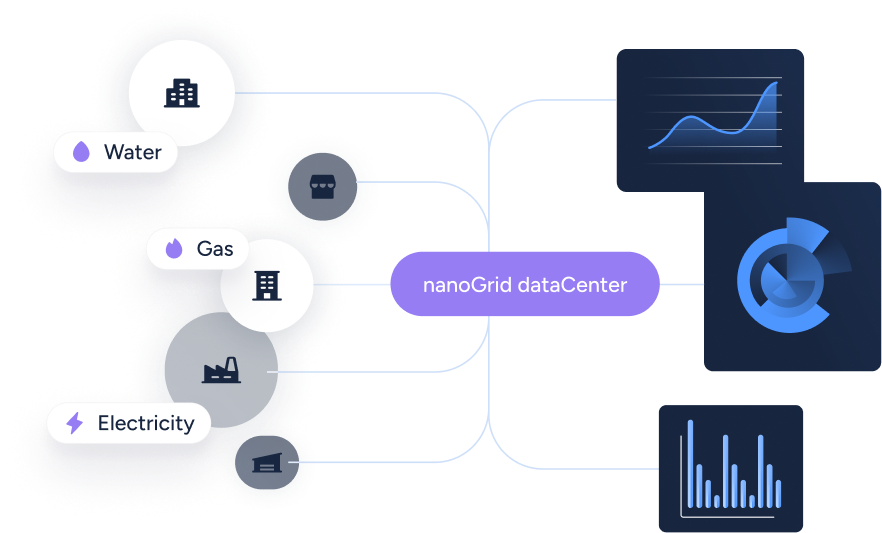
nanoGrid connects to all existing meters regardless of type, age, or protocol, and delivers continuous, real-time, meter-level data across the entire portfolio. No manual reading. No invoice dependency. No gap in the record.
The five failure points above map directly to what nanoGrid delivers. Automatic baseline-quality data from day one, with time-series granularity for meaningful normalisation. Real-time EnPI dashboards with alert thresholds, so drift is caught in days, not billing cycles. Sub-meter level before-and-after data for every corrective action, so CAPAs close with evidence rather than estimates. Algorithmic anomaly detection with a documented alert history. And an immutable, exportable data archive ready for audit at any time.
Capturing utility data at source is the foundation. If your ISO 50001 system is running on invoice data, you are managing compliance on paper, not on evidence. The standard requires more, and so does the audit. nanoGrid gives you the data layer that makes the difference.
Stop managing ISO 50001 compliance on monthly totals. nanoGrid delivers the continuous, meter-level data the standard actually requires. Book a demo.
Frequently Asked Questions
What does ISO 50001 require for energy monitoring?
Clause 9.1 requires a measurement plan covering significant energy uses, EnPIs, and relevant variables, collected at a frequency appropriate to the variability of the energy use. For most building systems, that means sub-hourly or hourly data. Monthly invoice totals do not meet this requirement.
Can invoice data support ISO 50001 corrective actions?
No. Clause 10.2 requires before-and-after data at meter level to verify corrective action effectiveness. A monthly billing total cannot isolate the effect of a change from seasonal variation, occupancy shifts, or billing period misalignment.
What is the difference between invoice data and meter-level time-series data for ISO 50001?
Invoice data provides monthly totals, sufficient for annual ESG reporting but not for ISO 50001 compliance. Meter-level time-series data provides continuous, granular readings that support EnPI monitoring, anomaly detection, corrective action verification, and a defensible audit trail.