BREEAM vs LEED: Which Green Building Certification Fits Your European Portfolio?
If you manage buildings across Europe, this question will find you sooner or later. A global tenant demands LEED. Your investor expects BREEAM. Your sustainability lead wants to know: which one matters more?
The honest answer? Both matter. But they matter in different ways, for different reasons, and with different implications for your data infrastructure. The BREEAM vs LEED debate isn't really about which framework is better. It's about which one fits your portfolio, your markets, and your ability to produce the evidence each certification system demands.
More than 600,000 buildings hold BREEAM certificates across 93 countries. Around 100,000 LEED certified buildings span 180 countries. Together, BREEAM and LEED are the two most widely adopted green building certifications in the world. Yet the key differences between them catch portfolio managers off guard more often than they should.
This guide breaks it down. Scoring systems. Assessment categories. Certification processes. Geographic scope. And the uncomfortable truth that connects LEED and BREEAM: scoring well depends entirely on the energy data your buildings can produce.
What Are BREEAM and LEED?
BREEAM: Europe's Standard
BREEAM stands for Building Research Establishment Environmental Assessment Method. It was launched in 1990 by the Building Research Establishment (BRE) in the United Kingdom, making it the world's oldest sustainability assessment method for the built environment. Today, BREEAM is the standard for sustainable building practices across the UK and Europe. It evaluates environmental performance across ten categories, from energy efficiency and water consumption to pollution and land use. The environmental impact of a building is measured across its full life cycle.
For a full breakdown of scoring, levels, and energy requirements, read our guide on BREEAM certification.
LEED: The Global Benchmark
LEED stands for Leadership in Energy and Environmental Design. It was developed by the U.S. Green Building Council (USGBC) in 2000. The certification body is the Green Business Certification Inc. (GBCI). While LEED originated in the United States, its rating systems have become the most recognised green building certification globally. It is a preferred choice for multinational corporations and organizations operating across borders. LEED evaluates buildings across categories including sustainable sites, water efficiency, energy and atmosphere, materials and resources, and indoor environmental quality.
For a detailed look at how the LEED rating system works in European markets, see our guide on LEED certification.
BREEAM vs LEED: The Key Differences That Actually Matter
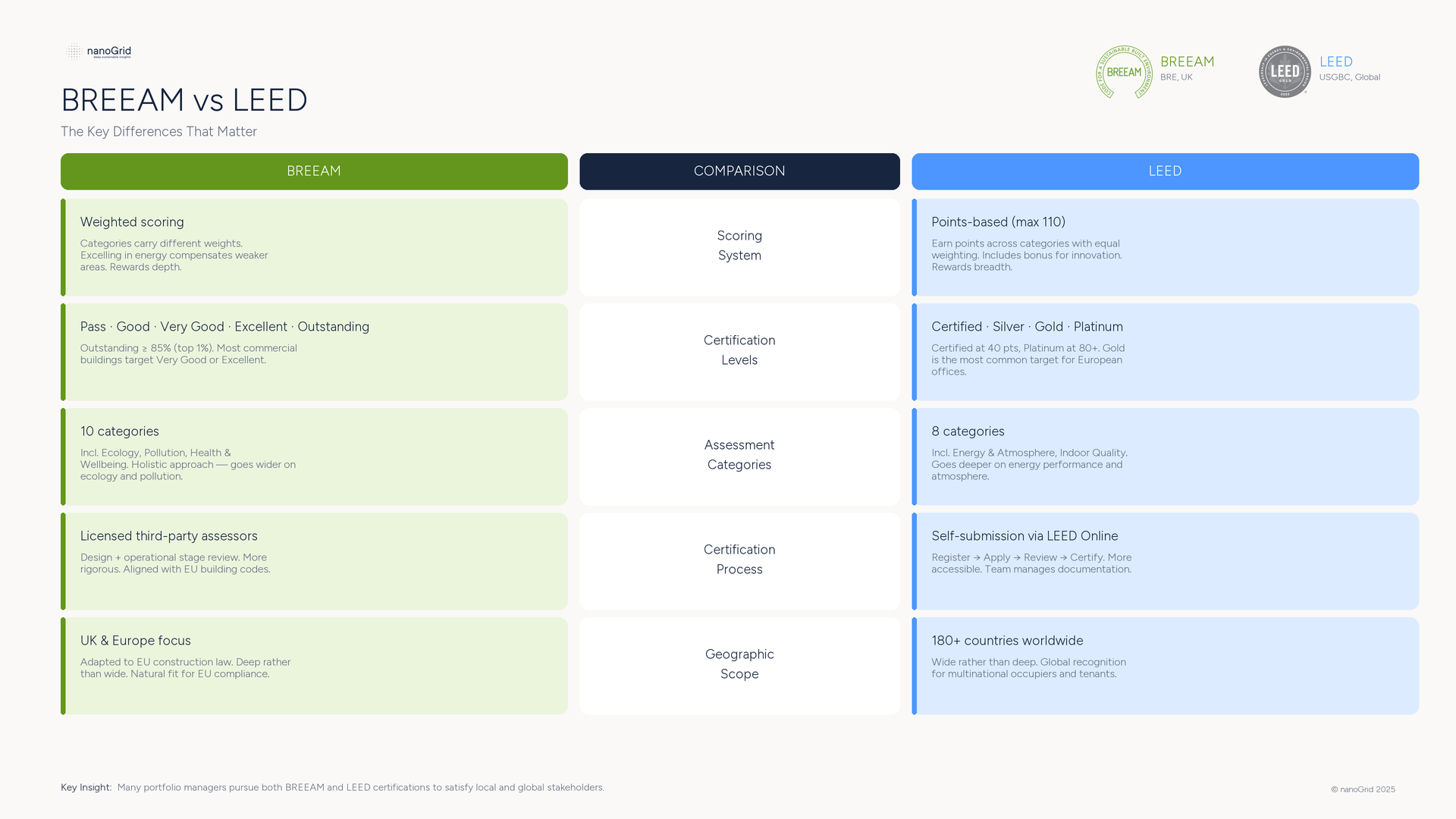
On the surface, BREEAM and LEED look similar. Both are green building certifications. Both assess environmental impact across the built environment. Both reward sustainable building practices with recognised rating systems. But the key differences between them shape which one fits your portfolio and how much effort certification requires.
Scoring Systems: Weighted vs Points
This is one of the most important key differences between BREEAM and LEED. BREEAM uses a weighted scoring system where different sustainability categories carry different weights based on their environmental significance. That means excelling in a heavily weighted category like energy can compensate for weaker scores elsewhere. But minimum standards still apply in critical areas.
LEED uses a point based system. Buildings earn points across categories and the total determines the certification level. A maximum of 110 points are available, including bonus points for innovation and regional priority. The scoring systems reflect fundamentally different philosophies. BREEAM rewards depth. LEED rewards breadth.
Certification Levels: Pass to Outstanding vs Certified to Platinum
BREEAM certification levels range from Pass, Good, Very Good, Excellent, to Outstanding. Achieving Outstanding requires a score of 85% or higher and represents the top 1% of buildings. Most commercial buildings target Very Good or Excellent.
LEED certification levels ranging from Certified (40 points) through Silver, Gold, to Platinum (80+ points). Gold is the most common target for European office buildings and logistics assets.
LEED and BREEAM certifications set high bars at the top. But the routes to the top are different. BREEAM demands licensed assessors and third-party auditing throughout. LEED allows the project team to gather documentation and submit directly. BREEAM is more rigorous. LEED is more accessible.
Assessment Categories: Where the Focus Areas Differ
BREEAM assesses buildings across ten categories: Energy, Water, Health and Wellbeing, Transport, Materials, Waste, Pollution, Land Use and Ecology, Management, and Innovation. It takes a holistic approach that includes ecological value, climate change adaptation, and occupant health.
LEED evaluates buildings across eight categories: Sustainable Sites, Water Efficiency, Energy and Atmosphere, Materials and Resources, Indoor Environmental Quality, Innovation, Regional Priority, and Integrative Process. LEED's focus areas lean more heavily toward energy efficiency and indoor environmental quality.
The overlap is real. LEED and BREEAM assess energy efficiency, water management, air quality, and sustainable materials. But BREEAM goes wider on ecology and pollution. LEED goes deeper on energy performance and atmosphere materials. Understanding these focus areas helps project teams allocate effort where it counts.
Certification Process: Assessors vs Self-Submission
The Building Research Establishment Environmental Assessment Method uses licensed assessors who examine the building's evidence against the credit criteria and report findings to BRE for assessment. The certification process involves both a design stage and an operational stage review. BREEAM accreditation requires this third-party rigour at every step across all building types.
Leadership in Energy and Environmental Design does not use licensed assessors. Instead, the project team gathers relevant information and submits evidence to the USGBC for examination through LEED Online. The certification process is a four-step path: registration, application, review, and certification. Both LEED and BREEAM require documentation of sustainable practices, but the route to producing that evidence is fundamentally different.
This matters for European portfolios. BREEAM's process is more aligned with local building codes in the UK and Europe. LEED's flexibility allows easier application across international markets but requires internal teams to manage documentation themselves. Either way, the environmental impact of poor data preparation is the same: delays, failed submissions, and certification scores that don't reflect actual building performance.
Geographic Scope: Where Each Certification Leads
BREEAM has a strong foothold in the UK and Europe. It is adapted to European construction law and local regulations. For buildings that need to comply with European standards, BREEAM is the more natural fit. The geographic scope is deep rather than wide.
LEED's geographic scope is the opposite: wide rather than deep. It is recognised in over 180 countries and has the global recognition that appeals to multinational occupiers. For European portfolios with global tenants, LEED provides a consistent benchmark across every market.
Many portfolio managers don't choose between BREEAM or LEED certification. They pursue both. Some high-profile building projects hold BREEAM and LEED certifications to satisfy local and global stakeholders simultaneously.
Which Framework Fits Your European Portfolio?
The choice between BREEAM and LEED depends on three things: who occupies your buildings, who invests in them, and where they sit.
Choose BREEAM When:
Your portfolio is concentrated in Europe. Your investors reference GRESB or CRREM. Your buildings need certification aligned with European building codes. You want a certification system that evaluates sustainability performance with rigorous, third-party auditing by licensed assessors. BREEAM is also essential for operational buildings, and BREEAM In-Use provides ongoing certification that tracks real performance year after year.
Choose LEED When:
Your tenants are global corporations who require consistent green building certifications across every market. Your buildings serve multinational occupiers who benchmark against LEED worldwide. You want a framework with a streamlined path to certification and broad international recognition. LEED's Operations and Maintenance (O+M) pathway covers existing buildings that need ongoing environmental performance validation.
Choose Both When:
Your portfolio spans multiple markets with mixed tenant demands. LEED and BREEAM certified buildings in your portfolio signal commitment to environmental responsibility at every level. The challenge with dual certification is not strategic. It's operational. BREEAM and LEED require verified energy data, water usage records, air quality monitoring, and waste management documentation. Running two frameworks from a single data infrastructure is only possible when that infrastructure is built for it.
Is BREEAM or LEED Better for European Real Estate Portfolios?
Neither is universally better. BREEAM is more deeply integrated with European sustainable building practices and regulatory frameworks. It is widely adopted as the default across the UK and continental Europe. LEED offers worldwide reach that matters for cross-border portfolios and international tenants.
The real question isn't which framework to choose. It's whether your buildings can produce the data that either framework requires. BREEAM and LEED are both moving toward data-driven, performance-based assessment. BREEAM through its In-Use scheme. LEED through its v5 update, which ties roughly 50% of available points to decarbonisation. The frameworks reward buildings that can prove their environmental performance with verified, continuous data.
What Energy Data Do You Need for BREEAM and LEED Certification?
This is where most certification journeys hit a wall. And it applies equally to BREEAM and LEED.
Achieving BREEAM Excellent or Outstanding requires verified energy consumption data, sub-metering at system level, and full traceability from meter to report. Scoring LEED Gold or Platinum demands advanced metering, ongoing commissioning evidence, and real-time monitoring that proves buildings perform as designed.
LEED and BREEAM significantly reduce operational costs through improved energy and water efficiency. But you only get those savings if you can measure them. And you only earn the certification credits if you can prove them.
For European portfolios, the data challenge has two layers. First, most existing buildings rely on manual meter readings, invoice-based estimates, or fragmented data from multiple systems. None of that survives a serious BREEAM assessment or a LEED submission at Gold level. Second, LEED is designed around ASHRAE standards. European buildings use M-Bus, Modbus, and other local protocols. Your data infrastructure needs to bridge that gap, translating between what your meters capture and what each framework expects.
Building analytics software can help improve a building's BREEAM or LEED rating by providing insights into environmental performance. But analytics without accurate, continuous source data is just guesswork with a dashboard.
Can a Building Hold Both BREEAM and LEED Certification?
Yes. And some of the most valuable certified buildings in Europe do exactly that. Dual certification demonstrates environmental responsibility to both local and international stakeholders. It satisfies European investors who reference BREEAM and global occupiers who benchmark against LEED.
The practical challenge is data, not process. The certification systems require evidence across overlapping categories: energy efficiency, water conservation, indoor air quality, sustainable materials, carbon emissions, and waste management. If your data infrastructure can capture verified, traceable performance data across all these areas, certifying against BREEAM and LEED becomes a configuration question rather than a capability question.
The Data Infrastructure That Powers Both: How nanoGrid Supports BREEAM and LEED
LEED and BREEAM reward what you can prove. Verified energy data. Traceable water figures. Documented air quality. Auditable carbon footprint records. The frameworks differ in how they score, their focus areas, and geographic scope. But they agree on one thing: without reliable, continuous data from your buildings, certification scores stay low.
That's the problem nanoGrid was built to solve.
Hardware in Every Building
nanoGrid's hardware sits physically inside your buildings, on every relevant meter, capturing real-time energy monitoring data around the clock. nanoScope reads legacy meters without replacement. No rip and replace. No disruption to building operations. Whether your meters speak M-Bus, Modbus, or pulse output, nanoGrid captures the data in a single, standardised stream. That stream feeds BREEAM and LEED submissions from one deployment.
Full Data Traceability
Every data point flows through our meter-to-cloud infrastructure into a hierarchical model: country, site, building, meter. Every reading is time-stamped, validated, and audit-ready. That traceability is what BREEAM assessors demand and what LEED submissions require. It's also what GRESB and CRREM expect when you report sustainability performance across your portfolio.
One Platform, Multiple Frameworks
nanoGrid's API-first architecture delivers data in whatever format your certification submission, ESG platform, or IoT energy monitoring system requires. BREEAM or LEED. European or global. New construction or existing buildings. One data infrastructure serves them all through integrated compliance and sustainability reporting.
Leading European portfolios already rely on nanoGrid. WDP captures real-time utility data across 300+ buildings in six countries. Belfius cut gas consumption by 28% through real-time HVAC control. These results come from having the data infrastructure to prove performance, not from choosing one certification over another.
The Framework Doesn't Matter If Your Data Can't Back It Up
The BREEAM vs LEED comparison matters. Each green building certification serves different markets, different stakeholders, and different levels of rigour. Understanding the key differences helps you choose wisely for your portfolio.
But the choice of framework is never the bottleneck. The bottleneck is data. Can your buildings produce verified, continuous, audit-ready energy data across every site? Can you trace every reading from meter to report? Can you feed BREEAM and LEED from a single source of truth?
nanoGrid makes that possible. From legacy meters to modern sub-meters, our hardware and software deliver the data infrastructure that green building certifications demand. Ready to see what audit-ready data looks like across your portfolio? Book a demo and find out.