BREEAM Certification Explained: Rating levels, energy credits, and what your data must prove

Every portfolio manager in European real estate has heard of BREEAM certification. Over one million buildings carry it. More than 2.9 million are registered across 103 countries.
A meta-analysis of more than 70 academic studies found that 77% reported statistically significant rental uplifts for green-certified buildings compared with non-certified stock (SUSTAINALYTICA, 2025).
And yet, most of those same portfolio managers will tell you they don't fully understand what scoring Excellent or Outstanding actually demands. Not at a surface level. At the evidence level. The level where your assessor asks for 12 months of verified energy data and you realise you don't have it.
That gap between "we know BREEAM matters" and "we can produce what the assessment criteria require" is where this article lives. We'll walk through the rating levels, the ten categories, the certification process, and the energy data question. If you're evaluating how BREEAM compares to LEED for a cross-border portfolio, start here.
What Is BREEAM Certification?
BREEAM stands for Building Research Establishment Environmental Assessment Method. The Building Research Establishment (BRE) launched it in 1990 in the United Kingdom. It was the world's first sustainability assessment for buildings. Over three decades later, it remains the most widely adopted.
Today, BREEAM certification is used in over 80 countries to evaluate the environmental performance of sustainable buildings across their full life cycle. It is not mandatory everywhere. But local authorities across Europe frequently require it for publicly funded developments and large commercial buildings. In practice, it has become the baseline that serious property investors measure against.
What makes this framework different from narrower standards? Scope. BREEAM's holistic approach covers energy, water, waste, transport, materials, health, management, pollution, land use, and innovation in a single sustainability assessment. It spans environmental and social governance dimensions together. The breadth of the assessment criteria is why BREEAM has become the dominant sustainability framework across the European built environment.
For building owners managing dozens or hundreds of sites, that breadth is both the appeal and the challenge. A BREEAM certified building proves performance across the full range of sustainability criteria. Not just one metric. Not just one quarter.
BREEAM Certification Levels: From Pass to Outstanding
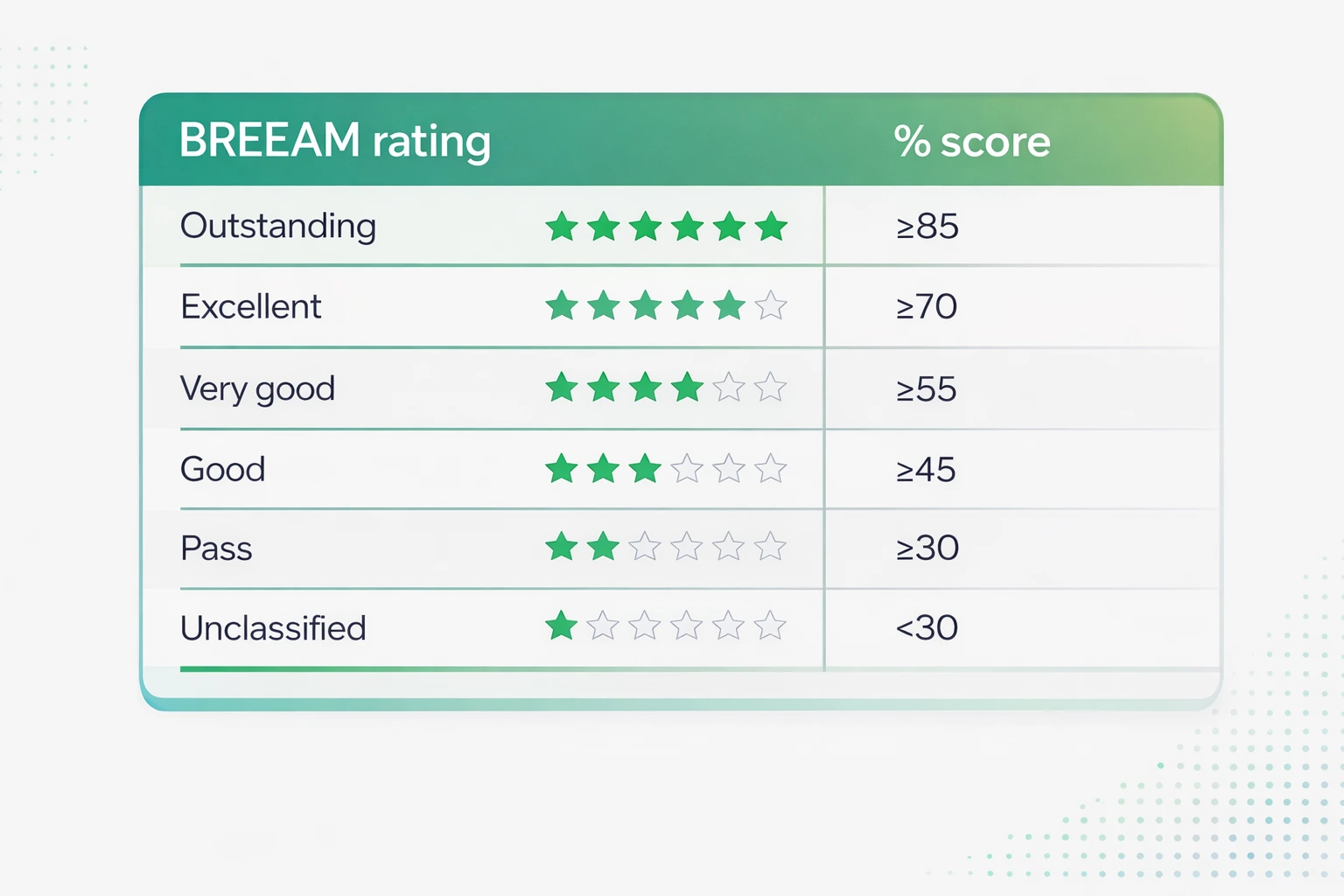
The Five Levels
Every BREEAM assessment produces a percentage score. That score maps to one of five BREEAM rating levels:
- Pass (≥ 30%)
- Good (≥ 45%)
- Very Good (≥ 55%)
- Excellent (≥ 70%)
- Outstanding (≥ 85%)
Each BREEAM rating level reflects how well the project meets the BREEAM criteria. But raw percentages don't tell the full story. Minimum performance standards apply in key areas regardless of your total score. You cannot fail on energy and make up for it with a strong waste strategy.
What Separates Good From Outstanding?
Less than 1% of BREEAM certified buildings achieve an Outstanding rating. It identifies the top 1% of non-residential buildings. It means advanced good practice combined with genuine innovation. That's the territory where assessment criteria stop being a checklist and start demanding proof.
Most commercial fit outs target Very Good or Excellent as a minimum. That's the range where investors pay attention and BREEAM scoring starts to influence asset valuation.
Here's what portfolio managers need to understand:
The jump from very good to excellent is not about trying harder. It's about data. Verified operational data, not design assumptions.
At that level, your sustainability goals depend entirely on what you can measure, document, and trace.
The Ten BREEAM Assessment Categories
BREEAM assesses sustainability performance across ten categories. Each is weighted based on its environmental significance. Together, they determine your final BREEAM rating. But not all categories carry equal weight, and not all present equal difficulty.
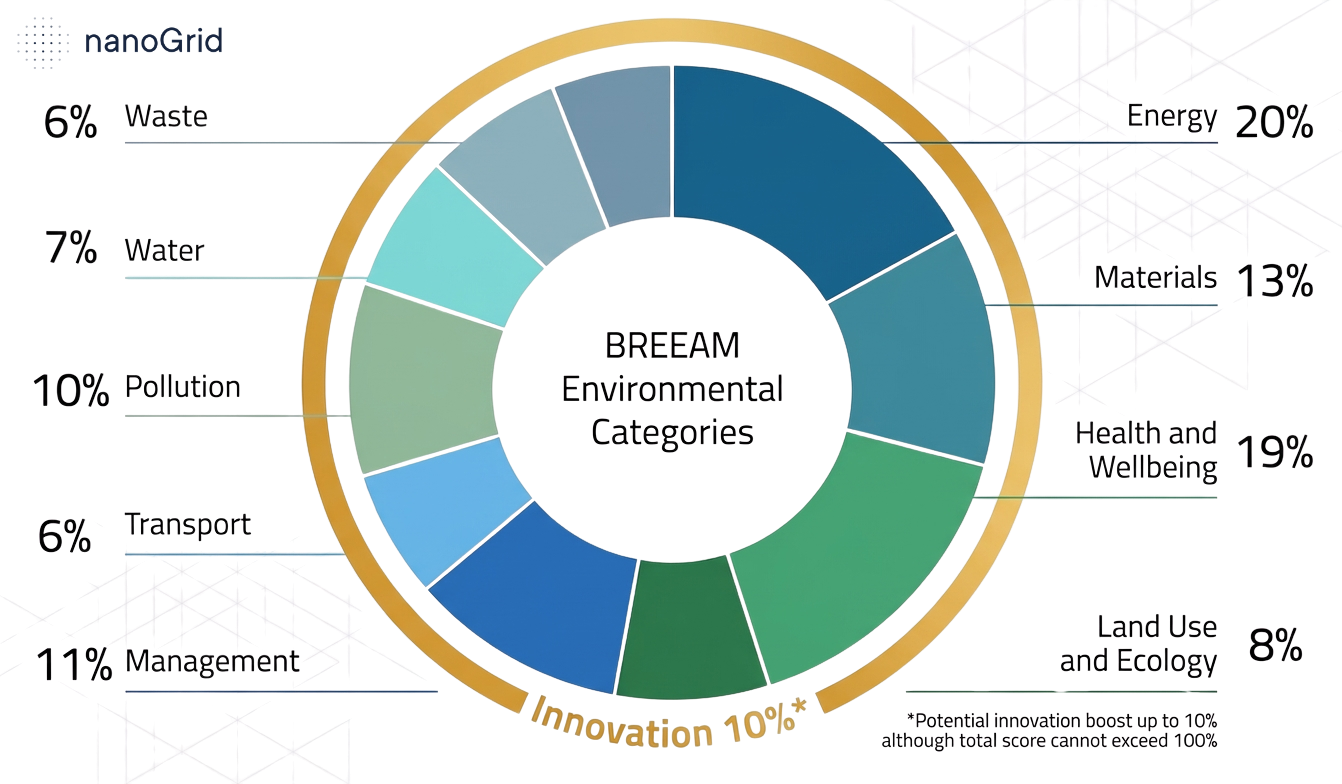
Energy: Where Most Portfolios Win or Lose
The Energy category carries the heaviest weight in most BREEAM schemes. It measures energy efficiency across all building systems: heating systems, cooling, ventilation, lighting. The assessment criteria focus on energy consumption patterns, submetering provisions, and renewable sources.
This is where building performance separates from building promises. Verified consumption records. Time-series metering. Evidence of energy usage reduction. Carbon emissions targets that feed directly into your score. These requirements increasingly align with EPBD and BACS compliance requirements across Europe.
If you only optimise for one category, make it this one.
Management, Health and Wellbeing
Management evaluates the processes that minimise environmental impact during construction and operation. Your project teams need to demonstrate commissioning, stakeholder engagement, and climate change adaptation.
Health and Wellbeing examines indoor air quality, natural lighting, thermal comfort, and acoustics. Both categories demand documented evidence across the project lifecycle. No documentation, no credits.
Materials, Water, and Waste
Materials evaluates environmental impact throughout the life cycle of building products. It encourages circular economy principles. Water targets consumption reduction. Waste management strategies must show waste reduction, recycling, and landfill diversion.
Transport, Pollution, Land Use, and Innovation
Transport scores proximity to public infrastructure, electric vehicles provisions, and alternative commuting. Pollution covers contamination of the surrounding environment. Land Use and Ecology protects ecological value and biodiversity on site.
Innovation deserves a separate mention. It rewards sustainable building design approaches that go beyond standard practice. For teams with strong environmental performance across core categories, Innovation credits can push a Very Good into Excellent.
BREEAM Schemes: Which One Applies to Your Project?
BREEAM is not one standard. It is a family of schemes. Each targets a specific project phase or building type. As a sustainability rating scheme, it covers everything from new builds to operational portfolios across the built environment. Choosing the wrong scheme wastes time. Understanding the right one focuses your effort.
BREEAM New Construction and BREEAM Refurbishment
BREEAM New Construction covers new builds from design through to handover. It requires a design stage assessment followed by a post-construction review before final certification. This applies to office buildings, retail, logistics, and education facilities across Europe.
BREEAM Refurbishment and fit out covers renovation and interior fit out projects. It lets teams integrate sustainability measures early in the fit out process. Most commercial fit outs in Europe now target at least Very Good under this scheme.
Both new construction and BREEAM refurbishment share the same ten assessment categories. The difference is timing. New construction captures intent. BREEAM refurbishment and fit out captures what you actually deliver.
BREEAM In-Use: The Scheme That Never Stops
BREEAM In-Use is the scheme for existing, operational buildings. It evaluates asset performance across three parts: Asset Performance, Building Management, and Occupier Management.
BREEAM In-Use certification is valid for three years. After that, renewal demands updated operational asset data. This is not a one-time exercise. It demands ongoing proof of sustainability performance. For multi-site portfolios, that means your data infrastructure needs to scale, or your BREEAM In-Use rating doesn't survive contact with reality.
If new construction is about getting BREEAM certified, BREEAM In-Use is about staying certified.
BREEAM Infrastructure, Communities, and Home Quality Mark
BREEAM Infrastructure applies to civil engineering and infrastructure projects. Roads, railways, bridges, utility networks. Civil engineering teams use it to assess sustainable design and environmental impact across large-scale developments and regeneration projects.
The BREEAM Communities standard covers masterplanning at neighbourhood scale. It assesses sustainable development, social impact, and resilience for BREEAM Communities projects.
The Home Quality Mark is BRE's residential quality label, helping homebuyers identify sustainable buildings with verified environmental performance. While the Home Quality Mark serves a different audience, it shares BREEAM's methodology. Like BREEAM Infrastructure and BREEAM Communities, the Home Quality Mark extends the framework across every segment of the sustainable built environment.
The BREEAM Certification Process Step by Step
Obtaining BREEAM certification follows a clear path. The full name, Building Research Establishment Environmental Assessment Method, reflects the framework's rigour. The BREEAM certification process applies regardless of scheme, though details vary by project type.
Register, Appoint, Collect
Start by registering the project on the BREEAM website and selecting the relevant scheme. Then appoint a licensed BREEAM assessor. This is not optional. BREEAM assessments are carried out by licensed professionals who guide evidence collection, compile findings, and submit the assessment report to BRE for quality assurance.
New Builds and Refurbishments: Design to Handover
For new construction and BREEAM refurbishment, the process includes a design stage assessment and a post-construction review. Once BRE approves, final certification and the BREEAM rating are issued.
Operational Buildings: Prove How You Perform
For BREEAM In-Use, the certification process focuses on operational asset data. Building managers must provide evidence of energy consumption, waste management practices, indoor air quality standards, and management procedures. The BREEAM assessment evaluates how the building actually performs. Not how it was designed to perform.
One pattern we see repeatedly across portfolios: BREEAM certification works best when sustainability measures are built into operations from day one. Retrofitting evidence after the fact is always slower and more expensive.
Why BREEAM Certification Matters for Portfolio Owners
The Financial Case
BREEAM certified buildings command rental premiums of up to 20.6% and carry higher resale values. BREEAM certification can unlock "Green Finance" opportunities including lower-interest green bonds and mortgages. It reduces operating costs through energy efficiency. And it helps enable property investors to demonstrate their environmental and social governance commitments.
Reputation, Wellbeing, Retention
A BREEAM certification signals something concrete. It demonstrates measurable commitment to reduce carbon emissions and tackle climate change. Certified sustainable buildings support occupant wellbeing through healthy indoor air quality, better lighting, and thermal comfort. That translates directly into tenant retention.
BREEAM provides a structured framework for continuous sustainable improvements in sustainability performance over time. Building owners can track progress against clear benchmarks rather than vague ambitions.
The UK Government and local authorities increasingly reference BREEAM standards in planning requirements. Having BREEAM accreditation is shifting from differentiator to baseline. Environmental sustainability is no longer a selling point. It's a requirement.
What Energy Data Does a BREEAM Assessment Require? And How nanoGrid Delivers It
This is where most BREEAM ambitions hit a wall.
Scoring Excellent or Outstanding requires verified, granular energy data. Submetering at system level. Time-series consumption records. Full traceability from meter to report. Your licensed BREEAM assessor will ask for all of it. And most portfolios don't have it.
The problem isn't intent. It's infrastructure. Fragmented data sources. Delayed meter reads. Invoices that don't survive an audit. Manual spreadsheets that nobody trusts. You can't achieve environmental targets with data you can't prove.

nanoGrid solves this at the source. Our hardware sits physically inside your buildings, on every relevant meter, capturing real-time energy monitoring data around the clock. nanoScope reads legacy meters without replacement. No rip and replace. No disruption. Data flows through our meter-to-cloud data infrastructure into a hierarchical model: country, site, building, meter. That structure matches what BREEAM's site-level reporting demands.
Accurate, continuous operational asset data has helped improve asset performance across portfolios like WDP and Goodman. When your BREEAM assessment demands proof, nanoGrid delivers valuable insights backed by audit-ready data. That's how you move from "targeting Excellent" to actually proving it.
Your BREEAM Rating Is Only as Strong as Your Data
BREEAM certification rewards what you can measure. Not what you intend. Whether you're pursuing BREEAM New Construction, BREEAM In-Use for existing assets, BREEAM Refurbishment for a fit out programme, or BREEAM Infrastructure for civil engineering projects, the common thread is verified building performance data. Traceable and continuous.
The challenge for multi-site portfolios isn't understanding the BREEAM rating system. It's producing the energy data that assessors need to award higher scores.
nanoGrid delivers that data. From legacy meters to modern sub-meters, our hardware captures real-time utility data across your entire portfolio. Every reading is traceable. Every dataset audit-ready. Leading European portfolios already rely on this infrastructure to support their BREEAM, GRESB, and CRREM reporting through integrated compliance and sustainability reporting.
Ready to see what audit-ready energy data looks like for your portfolio? Book a demo and find out.