BREEAM In Use: How Ongoing Certification Demands Real-Time Energy Data

By 2050, over 80% of the buildings in use across the world will already exist today. They're already built. Already occupied. Already consuming resources. The sustainability challenge in the built environment isn't just about designing greener new buildings. It's about proving that your existing assets actually perform.
That's exactly what BREEAM In-Use was built for. It's the only BREEAM scheme that focuses entirely on operational buildings, assessing how they perform in the real world, not on paper. For property investors, owners, managers and occupiers managing large portfolios, BREEAM In-Use is quickly becoming the standard for demonstrating environmental performance and drive sustainable improvements across existing assets.
But here's what most organisations discover only after they start: maintaining a BREEAM In-Use certification year after year requires data infrastructure that most buildings simply don't have. If you're comparing frameworks, read our guide on BREEAM vs LEED first. This article goes deeper into the in use scheme that never stops asking for proof.
What Is BREEAM In-Use?
BREEAM In-Use is an internationally recognised sustainability assessment and certification scheme for existing non-domestic buildings. Developed by BRE, it provides a framework to enable property investors, owners managers and occupiers to measure, benchmark, and improve the operational performance of their assets throughout the building's operational life.
Unlike BREEAM standards for new construction or refurbishment, which assess design intent, BREEAM In-Use evaluates what actually happens inside your buildings every day. The BREEAM In-Use standard is structured around two core parts:
Asset Performance
This part evaluates the physical characteristics of a building. The fabric, the systems, the asset's location, proximity to local amenities and transport links. It measures the inherent qualities of the asset itself, independent of how it's managed.
Management Performance
This is where operations come under the spotlight. Management performance assesses the policies, procedures, and practices used to run the building efficiently. Energy use tracking, waste management, occupant engagement, maintenance schedules. It's the part that separates buildings that were built well from buildings that are run well.
BREEAM In-Use assessments can be conducted for an entire building or a single floor, as long as the scope includes all relevant amenity and service areas. The assessment can also be tailored to reflect who controls each part of the operation, whether that's the owner, the facilities manager, or the tenant.
Nine Categories, One Score: What BREEAM In-Use Actually Measures
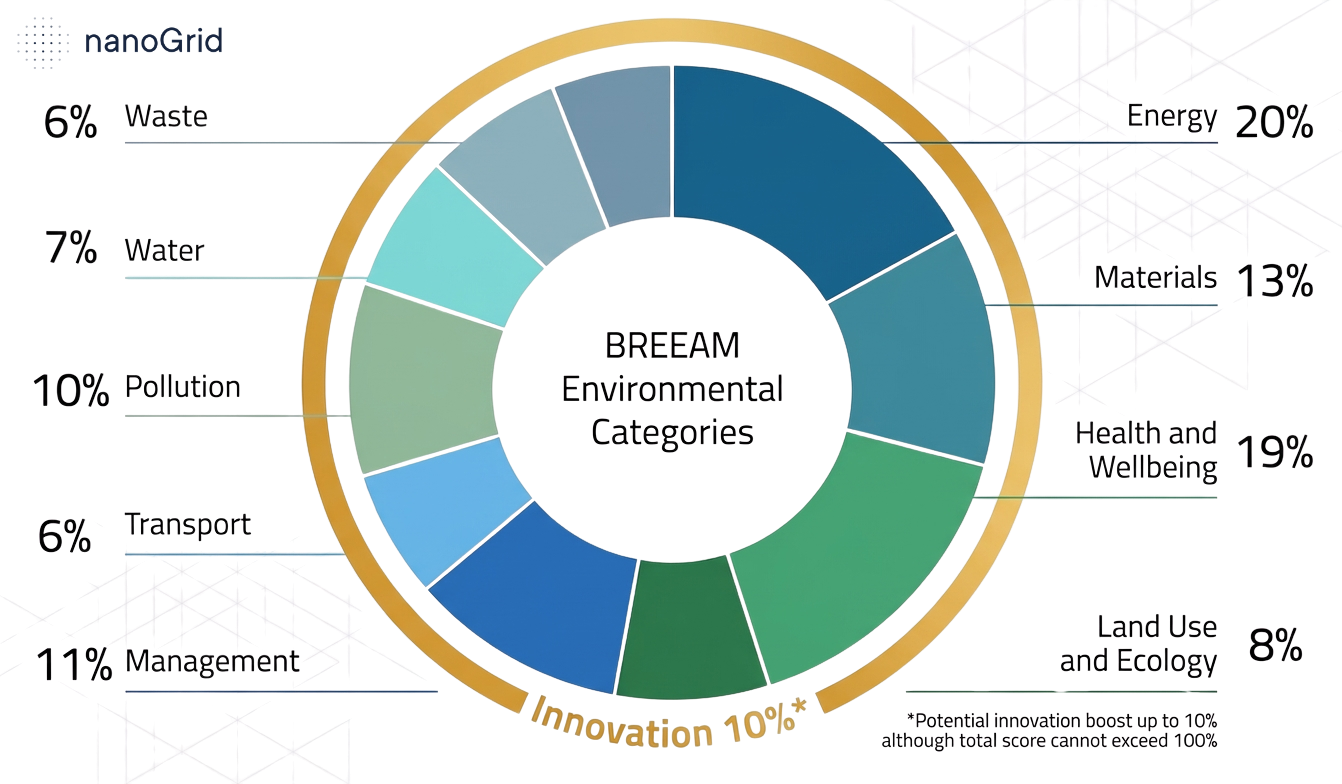
BREEAM In-Use assessments cover nine environmental categories that affect the sustainability and operational life of buildings across the world. Each category contributes to a weighted score across the following criteria:
- Energy: Assessing whether the property uses efficient technologies, renewable electricity, and effective monitoring. This is where most assets win or lose.
- Water: Evaluating sustainable water use practices, potable water consumption levels, leak detection systems, and monitoring quality.
- Health and Wellbeing: Examining occupant comfort across temperature, air quality, lighting, and acoustics. The BREEAM In-Use standard values accessible environments that support health and productivity.
- Transport: Assessing the building's connectivity to transport infrastructure and local amenities.
- Waste: Evaluating waste reduction strategies, recycling rates, and circular practices.
- Materials: Assessing how building materials perform across their lifespan, including resilience and reuse potential of assets.
- Pollution: Measuring contributions to local contamination and the impact on surrounding communities.
- Land Use and Ecology: Protecting ecological value, biodiversity, and land use on and around the site.
- Management: Assessing whether building managers provide training, information, and clear management systems to minimise environmental impact.
Certification levels range from Acceptable to Pass, Good, Very Good, Excellent, and Outstanding. The BREEAM In-Use standard uses a 6-star rating system to reflect performance across these environmental categories. Getting a certified rating of Excellent or Outstanding puts assets in the top tier globally.
Why Portfolio Owners and Asset Teams Pay Attention
BREEAM In-Use is not just a sustainability label. It's a risk mitigation tool, a value driver, and a reporting framework in one.
Financial Value
Certified assets can achieve up to 20% higher valuations on average compared to non-rated properties. BREEAM In-Use can increase an asset's market appeal, supporting both rental demand and long-term sales value for assets across your portfolio. An effective management system contributes to lower operational costs through improved efficiency and resource management. That directly protects asset value.
ESG Alignment and Reporting
The BREEAM In-Use standard supports disclosures and reporting requirements. For portfolios reporting to GRESB, following CRREM pathways, or preparing for CSRD compliance, BREEAM In-Use provides independent third party assurance that operational data is verified and credible. This third party assurance strengthens your reputation in procurement and stakeholder reporting.
Risk Mitigation and Resilience
BREEAM In-Use helps manage risks associated with legislation and climate change. For owners with long term strategies around net zero carbon, the scheme provides a clear path to reduce environmental impact and carbon emissions across existing assets. Net zero targets don't mean much without verified data to back them. BREEAM In-Use delivers that assurance, building long term resilience into every asset.
The benefits of BREEAM In-Use extend to occupants too. More comfortable, well-maintained spaces. Better air quality. Lower operational costs passed through to tenants. These benefits of BREEAM aren't abstract. They show up in retention rates and occupier satisfaction scores across certified assets.
How the BREEAM In-Use Assessment Process Works
Find Your Assessor
To start, reach out to licensed BREEAM assessors or In-Use auditors. They register your property for assessment and guide the evidence collection across all nine environmental categories.
Choose Your Scope
The BREEAM In-Use assessment process allows a phased approach. You can begin with benchmarking your assets and then progress to full certification of individual assets or groups. This aligns with investment strategies and avoids a costly all-or-nothing commitment. Assessments cover different building types across your portfolio, from offices to logistics to retail.
Submit and Certify
BREEAM assessors compile evidence and submit findings to BRE Global for quality assurance. Once approved, your BREEAM In-Use certification and BREEAM rating are issued. The scheme allows for independent ratings across both asset performance and management performance, so you can track exactly where each building stands.
The assessment process encourages continual improvement. Each recertification cycle lets you set new performance targets and quantify progress against previous scores. That's what makes this in use scheme fundamentally different from one-time certification. It never stops asking: how are you performing now?
How Often Does BREEAM In-Use Need to Be Renewed?
The full recertification cycle for BREEAM In-Use occurs every three years, allowing organisations to quantify their progress and demonstrate sustainable improvements over time. Between recertification cycles, ongoing data collection and monitoring are essential to support the next assessment. The BREEAM In-Use standard also supports annual updates to keep sustainability performance on track and close any performance gap before the formal renewal.
What Data Does a BREEAM In-Use Assessment Require?
This is where ambition meets reality. BREEAM In-Use demands verified operational data across every category. Asset performance evidence. Energy use records. Water consumption figures. Waste management documentation. Air quality monitoring. Evidence of building management practices. All traceable. All auditable.
For a single building, that's manageable. For a portfolio of 50, 100, or 300 buildings across multiple countries? That's an infrastructure problem. Manual meter readings and quarterly invoices won't survive a serious BREEAM In-Use assessment. You need continuous, automated, audit-ready data.
How Does BREEAM In-Use Relate to GRESB Scoring?
GRESB rewards portfolios that can demonstrate verified building performance data. BREEAM In-Use provides exactly that: independent, third party assurance of operational performance across standardised categories. A strong BREEAM In-Use score feeds directly into your GRESB submission, giving stakeholders the confidence that your sustainability claims are backed by evidence. For portfolios targeting top-quartile GRESB results, BREEAM In-Use is one of the most efficient ways to support that ambition.
The Data Challenge Most Portfolios Won't Admit, and How nanoGrid Solves It

The BREEAM In-Use standard is clear about what it expects. Verified, continuous, operational asset data from every building in your portfolio. But most organisations managing existing buildings across Europe face the same problem: fragmented data, inconsistent metering, and zero traceability from meter to report.
The in use scheme helps improve the performance of buildings that are already in use, with support for benchmarking, assurance and validation of operational asset data. But you can only benchmark what you can measure. And you can only validate what you can trace.
nanoGrid solves this at the infrastructure level. Our hardware sits physically inside your buildings, on every relevant meter, delivering real-time energy monitoring data around the clock. nanoScope reads legacy meters without replacement. No disruption. No rip and replace. Data flows through our meter-to-cloud infrastructure into a hierarchical model that matches what BREEAM In-Use reporting needs: country, site, building, meter.
WDP uses nanoGrid across 300+ buildings in six countries to capture real-time utility data for ESG reporting. Belfius achieved a 28% gas reduction through nanoGrid's real-time HVAC monitoring. These aren't design-stage promises. They're operational results, verified and traceable. Exactly what BREEAM In-Use demands.
The benefits of BREEAM In-Use are real. But they only materialise when your data infrastructure can keep pace with the assessment cycle. nanoGrid delivers portfolio-level insights and compliance and sustainability reporting that support BREEAM In-Use, GRESB, and CRREM from a single platform.
BREEAM In-Use Rewards What You Can Prove
The world is shifting from "build green" to "operate green." BREEAM In-Use is the scheme built for that shift. It gives property investors, owners and managers a structured, internationally recognised path to drive sustainable improvements across their existing assets.
But certification is only as strong as the data behind it. Without continuous, verified, audit-ready energy data, your BREEAM In-Use score stays stuck. With it, you unlock higher BREEAM certification levels, stronger GRESB results, and real net zero progress.
Ready to see what audit-ready data looks like across your portfolio? Book a demo and find out.