Automatic Meter Reading vs. Real-Time Meter Data: What Multi-Site Businesses Actually Need

Most property teams managing 20 to 100+ buildings have the same quiet question. We already run automatic meter reading across our meters, isn't that enough? The answer depends on what you use the data for.
Automatic meter reading, or AMR, replaced manual meter reading in commercial buildings. It works. It removes field trips, feeds billing cycles, and catches obvious leaks. For decades that was the job.
Today the job has grown. CSRD audit trails, GRESB scoring, BACS compliance under the revised EPBD, and real-time operational decisions all demand something AMR was never designed to deliver: continuous, validated, API-accessible meter readings across every site.
This article walks through what automatic meter reading is, how it works, what it delivers, and where it falls short. By the end you will know whether your AMR setup is fit for purpose or whether you need a meter data management layer on top of it.
What is automatic meter reading?
Automatic meter reading is the technology that collects consumption data and status data from utility meters without a human walking up to record the number on a clipboard. An AMR device sits on or near the meter, reads the register at set intervals, and transmits data to a central database. Utility providers and energy suppliers then use that data for invoice generation, outage management, and demand forecasting.
The progression is straightforward. Manual meter reading came first. Automatic meter reading arrived in the 1980s and 1990s as the first step toward automated meter reading at scale, using handheld and drive-by systems for large utilities. Smart metering came next, adding two way communication and tighter intervals. The current frontier is connected meter data management, which pulls readings from AMR systems and smart metering estates together into one validated portfolio view.
Most AMR systems still use a one-way communication model. The meters transmit data. The utility receives it. There is no feedback loop, no remote configuration, and no real time analytics pushed back to the meters.
How does automatic meter reading work?
An AMR system follows three operational steps: data capture at the meter, data transmission over a network, and data processing in a central database. The details vary by the collection method the utility or building owner chose when the meters were installed.
Walk-by and drive-by AMR
Walk-by AMR uses a handheld receiver. A field technician walks past a building, the AMR device on the meter transmits its reading over short-range radio frequency, and the receiver captures it. Drive-by AMR uses a vehicle-mounted receiver. Field technicians drive a route and collect hundreds or thousands of meter readings per day from battery powered AMR devices on electricity meters, water meters, and gas meters.
Both methods remove manual meter reading but still require regular on site visits. They suit large utilities running dense urban routes with traditional meters. For multi-site property portfolios spread across countries, walk by and drive by collection is slow, expensive, and operationally brittle.
Fixed networks
Fixed network AMR takes the field technicians out of the loop. Every AMR device transmits data continuously or on schedule to a receiver installed on utility networks, and from there into a central database. Fixed networks give you greater range, more regular readings, and lower labor costs over time.
Fixed networks rely on one of three transport layers. Radio frequency AMR is the most common, with utility networks spanning entire service areas. Power line communication transmits electronic data over existing electricity cabling, primarily used for electric meter reading at scale. Cellular AMR transmits data directly over mobile networks and is increasingly the default for new deployments because the AMR device talks to the cloud without any local infrastructure.
The three-step AMR process
Every AMR workflow follows capture, transmit, and process. The meters record consumption. The AMR device transmits data on schedule. Central meter reading software ingests the meter readings and hands off to the billing process.
What automatic meter reading actually delivers
AMR solved a real problem and still solves it well. For the billing process, it works.
Automated meter reading removes manual intervention on every reading, cuts labor costs, and speeds up meter data collection. Energy suppliers move from estimated bills to actual consumption figures, reducing disputes and improving customer satisfaction. Accurate billing on real meter readings is now the baseline.
Cash flow improves for utility providers too. Invoicing on near real-time consumption data, not quarterly manual meter reading cycles, means revenue arrives sooner. Fewer trucks on the road and fewer human error corrections across utility networks too. For electric utilities, fixed network AMR also supports outage detection and demand forecasting.
For leak detection, an AMR device helps at the interval it captures. A fixed network setup sending hourly meter readings can flag water meters running all night. A walk-by collection reading monthly cannot. AMR solves the billing problem cleanly, but its value for detection depends entirely on how often the AMR device transmits data.
Where automatic meter reading falls short for multi-site portfolios
For a property portfolio that needs live operational data, compliance-grade audit trails, and integration with ESG reporting tools, AMR hits five hard limits.
One-way communication
Most AMR systems send data in one direction only, meter to central database. You cannot remotely reconfigure the AMR device, push firmware updates, or validate meter readings against expected ranges in real time. Two way communication is a smart metering feature, not an AMR one.
Batch intervals, not real time
Even a good fixed network AMR setup delivers batch data every 15 minutes, hourly, or daily. That suits the billing process. It misses the 3 AM gas usage spike or the lighting circuit that never switches off after midnight. Real time data at minute level is what you need for anomaly detection, and AMR does not deliver it by default.
No built-in validation
An AMR device captures raw meter readings. It does not apply automated validation, estimation, and editing the way a dedicated energy data management layer does. Outliers, zero reads, and stuck registers pass through untouched, which is a direct hit on data quality.
No audit trail at reading level
CSRD requires every figure in a sustainability report to be traceable back to the meter, with provenance and validation status. AMR output rarely carries that lineage. You receive a number, not a defensible record. Regulatory requirements under CSRD, GRESB, and BACS expect more.
Limited integration capabilities
AMR was designed to push data to utility billing systems, not to ESG platforms, BMS, or data lakes. Integration is usually bolt-on and fragile, not API-first.
Automatic meter reading vs. real-time meter data management
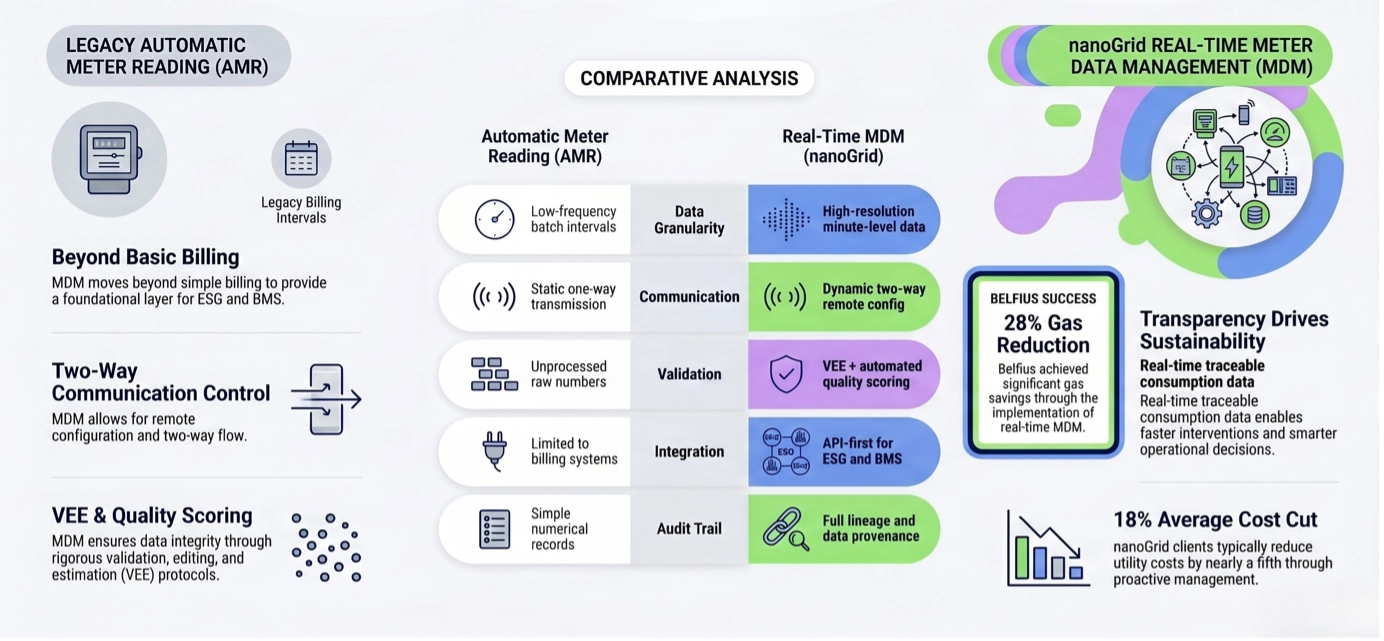
Lining up AMR against modern meter data management across five axes makes the gap clear.
Data granularity
AMR delivers batch meter readings at set intervals. Meter data management captures minute-level real time data and stores it in a time-series database with full hierarchy from country to site to building to individual meters.
Communication direction
AMR is one way. Meter data management supports two way communication with advanced meters and smart meters, enabling remote configuration and live status data.
Validation
AMR outputs raw numbers. Meter data management applies validation, estimation, and editing plus automated validation rules, giving you a data quality score on every reading.
Integration
AMR feeds the billing process. Meter data management exposes REST APIs so ESG platforms, BMS, and rebilling systems pull from the same validated source.
Audit trail
AMR gives you numbers. Meter data management gives you numbers plus full lineage, the backbone of regulatory compliance under CSRD.
The proof is operational. Belfius cut gas usage by 28% across 100+ offices using real-time anomaly detection and remote HVAC control. A plain AMR system, reading meters on an hourly batch cycle, would have flagged the anomaly weeks later and missed the saving. Continuous real time data combined with two way communication is what turned an observation into action.
Moving beyond automatic meter reading
Automatic meter reading did its job. It ended manual meter reading, cut labor costs, and gave energy companies accurate meter reading at scale. For billing, it still works.
For the problems a modern portfolio actually has, CSRD compliance, GRESB scoring, real-time anomaly detection, cross-site benchmarking across multiple meters, AMR alone is not enough. The gap is not the meters. It is the software layer between the meters and the decisions.
WDP proved this across 300+ logistics buildings in six countries, turning a mixed estate of legacy meters and modern AMR devices into one real-time view without replacing the underlying hardware. The same approach works for your portfolio. Ready to see what real-time meter data looks like on top of your existing AMR? Explore nanoGrid's meter-to-data technology or book a demo.
Frequently Asked Questions
What is the difference between smart meters and AMR?
A smart meter installed today supports two way communication, sends real time data, and lets the energy supplier push configuration changes remotely. AMR supports one-way transmission of meter readings on a schedule set by the AMR device or the utility.
Every smart meter can behave like an AMR device, but no AMR device can behave like a smart meter. Smart metering is the superset. AMR is the subset focused on automated meter reading for accurate billing. Advanced metering infrastructure combines smart meters with utility management software and networking.
Is automatic meter reading enough for CSRD or GRESB reporting?
On its own, no. CSRD assurance requires a full audit trail from meter to report. GRESB expects portfolio-wide coverage with granular, traceable consumption data. AMR delivers numbers but not the lineage or validation those frameworks expect.
You can still use your existing AMR hardware. A meter data management layer on top captures the AMR output, applies validation and estimation, and produces the audit-ready data CSRD and GRESB assessors want to see. Revenue protection and regulatory compliance both benefit from that extra layer.
Should we upgrade AMR to smart metering across a multi-site portfolio?
Not automatically. Ripping out working AMR hardware and installing new smart meters is expensive and rarely necessary. In many European countries, the utility controls the primary meter anyway, so a retrofit-friendly approach usually beats a full hardware swap.
A more efficient path is to add a meter data management layer that reads your existing AMR systems and smart meters together, normalises the data, and delivers one validated view across the portfolio. You gain the capabilities of smart metering without the capex of a full hardware swap across multiple meters.
Can we keep existing AMR hardware and add real-time meter data on top?
Yes, and this is usually the right answer. A hardware-agnostic meter data management platform connects to AMR devices over the protocols they already use, M-Bus, Modbus, pulse output, radio frequency, or cellular, and layers continuous real time data capture on top.
The result: you keep the amortised AMR investment, add minute-level data for real time analytics, and gain the validation, audit trail, and API integration your CSRD and GRESB workflows need. Modern AMR systems plus a connected meter data management layer is the pragmatic upgrade path for most portfolios.