BACS Requirements: Why your BMS isn't enough anymore

As we all know and see at our customers most large non-residential buildings already have a Building Management System (BMS).
It’s the default setup for managing HVAC, air conditioning, lighting, alarms, and comfort. But under the revised Energy Performance of Buildings Directive, that’s no longer enough.
The Energy Performance of Buildings Directive (EPBD) doesn’t ask if you have a BMS. It asks if your system performs like a Building Automation and Control System (BACS) and whether you can prove it.
By 31 December 2024, non-residential buildings with an effective rated output for heating, cooling or combined HVAC systems above 290 kW must be equipped with BACS, with this threshold falling to 70 kW by 31 December 2029 (EPBD Article 13, 2024; eu.bac, 2024).
These requirements apply to both new and existing buildings, making upgrades in existing buildings essential to meet compliance.
That means:
- Continuous logging of energy use and indoor conditions (IEQ monitoring)
- Retaining data for +12 months
- Detecting inefficiencies and triggering action
- Tracking system coverage and performance
- Providing evidence during inspections
BACS requirements cover a wide range of functions and systems, including heating, cooling, air conditioning, ventilation, and lighting, reflecting the broad scope of integration needed for effective energy management and compliance.
This is where many BMS setups fall short. They run the building day-to-day but they weren’t built to demonstrate compliance.
This article breaks down what the directive really asks for, how BACS compliance differs from traditional BMS capability, and what you can do today, building by building, to close the gap without ripping out your existing controls. We’ll also look at the implementation of these new requirements and how to put them into practice.
Quick overview
We’ll also show how to:
- Understand what auditors look for
- Apply the EN ISO 52120 / EN 15232 standards
- Build an audit pack with everything you need to pass
- Centralize BACS evidence across your portfolio
Let’s start by clarifying the core distinction: BMS is about control. BACS is about proof.
BACS vs BMS: The compliance gap
A Building Management System keeps your site running. It controls heating and cooling, manages lighting schedules, and alerts your team when something breaks. Under the EPBD, that’s not enough anymore.
The directive requires documented proof that your building automation actually improves energy performance. Control without measurement doesn’t meet compliance.
While BMS focuses on basic building operations, BACS requirements now demand more advanced solutions. BACS not only help achieve compliance but also streamline and enhance building processes such as energy management, monitoring, and maintenance, going beyond the traditional scope of BMS.
BACS systems are designed for advanced communication with a wide range of devices and subsystems, enabling seamless integration and real-time updates for better building management.
The complexity of BACS can vary, but all compliant systems must allow for central monitoring and recording of energy usage.
What the EPBD demands
The EPBD doesn't just require systems that operate buildings. It requires systems that prove performance through documented, auditable data.
That's the key difference: a BMS is a control platform. BACS is a regulatory standard. Your BMS might control your HVAC perfectly, but if it can't log energy consumption, benchmark efficiency, or produce audit-ready reports, it's not BACS compliant.
Why most BMS setups fall short
Most legacy BMS setups weren't built for EPBD compliance. Data logging is inconsistent or temporary. Storage is local, often overwritten weekly. You can show today's status, but not last month's performance or whether anomalies were resolved.
This isn't a technology failure. It's a purpose mismatch. A BMS optimizes comfort and control. BACS compliance requires documented energy performance and audit-ready evidence.
Building owners need systems that deliver proof, not just operation. Inspectors don't want dashboards. They want historical data, performance trends, and documented improvements. Without that, you're non-compliant, even if your building runs smoothly.
Next up: what inspectors actually check, and why real-time data alone won't pass an audit.
BMS is about running the building. BACS is about proving it runs well.

The Standards Behind the Directive
To understand what qualifies as a compliant Building Automation and Control System, you need to look at the two European standards that sit behind the energy performance of buildings directive: EN ISO 52120 and EN 15232. These are not just technical references. They are what inspectors and national authorities use to define whether a system is fit for purpose.
Networking building automation systems and ensuring compliance with these standards leads to cost savings and more sustainable energy use by enabling automated and optimized processes.
What EN ISO 52120 requires
EN ISO 52120 defines what a BACS-compliant system must do: monitor energy use, control building systems, and optimize performance based on real data.
A compliant system must:
- Continuously monitor energy consumption for each technical building system
- Detect faults and performance losses as they happen
- Log data in a structured way, with timestamps and trend visibility
- Allow for automatic adjustments to setpoints or schedules
- Track and report on indoor environmental quality (including temperature, humidity, and CO₂)
Interoperability is mandatory. Your BACS must communicate with devices and subsystems across different vendors. No vendor lock-in, no proprietary silos. You need open protocols and the ability to export data to third-party platforms.
If your system only logs today’s consumption and cannot link it to setpoints, occupancy, or system runtime, it likely does not meet this standard.
What EN 15232 adds to the picture
EN 15232 classifies the energy efficiency potential of BACS. It provides a rating from Class A (highly efficient) to Class D (inefficient), based on what the system actually does to improve energy use.
Class C is considered the baseline for compliance. But several Class B functions are now also required under the revised energy performance directive. These include:
- Benchmarking against historical data or expected values
- Visualisation of trends over time
- Integration of fault detection and automated response
How to self-assess your system
Ask yourself five key questions:
- Can I access at least 12 months of historical energy and IEQ data, per zone and system?
- Does the system detect anomalies or faults and flag them for action?
- Are alarms logged with timestamps and linked to resolution steps?
- Can I export reports for audits, ESG disclosures, or energy performance certificates?
- Is the system interoperable, or locked into one vendor’s tools?
If the answer to any of these is no, your system may not meet the functional expectations of EN ISO 52120 or the efficiency criteria of EN 15232, which are both used to judge compliance with the EPBD.
The audit : Evidence you’ll need to pass
A working system is not enough. Under the energy performance of buildings directive, what matters is whether you can prove that your building is being monitored, analysed, and optimised.
Auditors do not rely on dashboards. They look for structured evidence that shows how energy is managed, what was measured, what was flagged, and what was done. This is where many buildings fail. Not because the system is underperforming, but because there is no audit trail.
A complete audit pack helps you avoid that risk.
What should be in your audit pack?
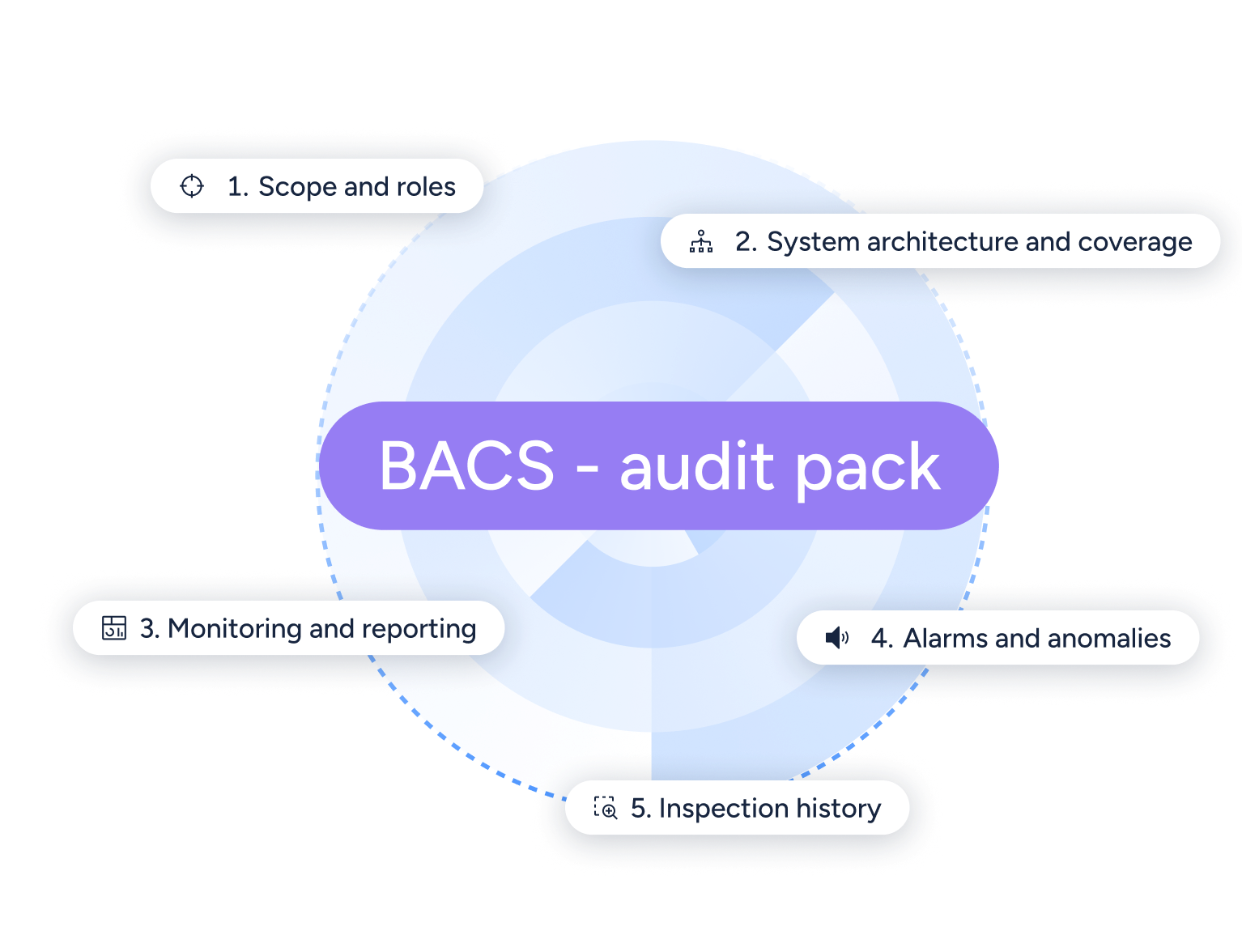
To pass a BACS inspection, your documentation should cover five areas:
1. Scope and roles
Start by clearly stating whether the building is in scope. Reference its rated output and show which technical building systems are covered. Include a contact person who is responsible for compliance and data access.
2. System architecture and coverage
Include a simple diagram that maps the building’s metering and sensor infrastructure. Show which systems are connected to your BACS layer. Make sure floor plans reflect IEQ sensor placement and that zone coverage is justified.
3. Monitoring and reporting
Provide 12 months of data, at minimum, covering electricity, heating, cooling, and indoor environmental quality. Reports should include trend charts, baselines, and comparisons across periods. Auditors want to see patterns, not snapshots.
4. Alarms and anomalies
List recent alarms, overrides, or flagged anomalies. More importantly, show what action was taken. Include timestamps, user comments, and any linked maintenance tickets. Passive systems do not meet the mark. Evidence of action does.
5. Inspection history
If the building has been inspected before, include the report and a record of follow-up actions. This closes the loop and shows you take compliance seriously.
Portfolio-Grade Compliance: Scaling Without Chaos
Compliance is not just a building-level problem anymore. As the energy performance of buildings directive rolls out across member states, building owners with multiple sites face a bigger challenge: proving compliance consistently, across the entire portfolio.
It’s one thing to prepare an audit pack for a single site. It’s another to do the same for twenty, fifty, or a hundred buildings each with different vendors, systems, formats, and data gaps.
This is where most portfolios start to unravel. You get:
- Local data stored in BMS trend logs with limited retention
- Alarms handled manually with no audit trail
- Reports prepared only after inspection requests
- No clear view of which sites are compliant, which are at risk, and which are behind
This fragmentation makes it almost impossible to scale BACS compliance. And it creates operational risk.
Why a central data layer is essential
To solve this, you need a dedicated layer that sits on top of your existing systems. One that connects to local BMS platforms, meters, sensors, and gateways. Then pulls everything into a single, structured environment.
This central platform becomes your portfolio’s source of truth. It standardises data, aligns tags across buildings, stores logs for the long term, and makes it easy to compare sites regardless of what brand of hardware or software they use.
This is exactly where nanoGrid fits in.
nanoGrid does not replace your BMS. It connects to it and to your meters, submeters, and IEQ sensors to:
- Log energy and IEQ data across all sites
- Store information securely and consistently
- Surface alerts, anomalies, and outliers
- Provide a unified view of audit readiness
- Support exports for EPCs, ESG reporting, and internal dashboards
At this level, energy performance is no longer a building-by-building project. It becomes a managed process: visible, trackable, and repeatable.
With a portfolio-grade data layer in place, you don’t need to scramble before an inspection. You already have the evidence. You already know which buildings are ready. And you can see which ones need action long before the audit.
Compliance Isn’t Optional, But Reinventing your setup Is
The EPBD changed the rules. You can't just manage comfort or claim efficiency on paper anymore. You need documented proof: traceable data, historical logs, and full system coverage.
But compliance doesn't mean replacement. You don't need to rip out your BMS or overhaul your infrastructure.
You need a central data layer that closes the BACS compliance gap. One platform that collects, stores, and standardizes energy data across your entire portfolio. It works on top of your existing systems, filling the gaps your local BMS can't handle.
The result: audit-ready documentation, performance tracking, and compliance with energy performance certificates and renovation passport requirements. No silos, no complexity.
With a solution like nanoGrid, you can connect what is already in place, add what is missing, and scale evidence across every asset in your portfolio. It is how you stay aligned with the buildings directive, national measures, and ESG expectations without costly structural interventions or disruptive upgrades.
Compliance is the baseline. What you build on top of it is where the real value starts.
📥 Download our BACS Compliance Playbook to get the full checklist, rollout steps, and audit-ready templates created for building owners and portfolio managers navigating BACS compliance across Europe.
Stream minute-level utilities and IEQ into one platform. See how nanoGrid helps you comply with confidence and scale it portfolio-wide. Contact us here.